Learning how to water plants to increase growth in pots, container or garden - especially how to water roots and tubers. Specialities: root growth or tuber growth of lawns, fuchsias, geraniums, dahlias and begonias.

Showing posts with label roots. Show all posts

5 August 2011

Two's Company . . .

uneven multiplant leavesuneven multiplant flowersThey say 'Two's company, three's a crowd'. I wonder if someone told my fuchsia multi-plants. For some reason, when produced from perlite-rooted cuttings, three plants will not grow together and produce even plants. Either one plant takes hold before the other two, or vise versa. As you can see, this affects both vegetative growth (left) and flowering (right).

This has happened each time I have placed three plants in a pot. Two have grown together. And they have ALWAYS grown together, whether larger or smaller than the third plant.

However, when I placed more than three rooted cuttings in a pot, multi-planting has worked, with all plants of similar size growing together. Strange.

The other strange thing is that, in the former case, although all three plants started at similar size, rooting occurred at differing times, thereby making the two groups uneven. i.e. for some reason one or two plants just would not root as quickly.

I suppose the obvious cause could be plants spaced too far apart. But I don't think it's as simple as this. Mysteries. Mysteries.

Still No Roots On Dahlia Cup Cutting

dahlia pot cutting not yet showing rootsStill no roots showing in dahlia cup cutting taken six weeks ago. Not sure what this means. It has taken and is growing;it is also flowering. When cuttings are rooted in spring, roots are usually visible at the bottom of the pot within four weeks, often sooner. I know a 500ml (pint) beer pot is much deeper, but they should have got down there by now. What's the reason?

  • dahlia roots are 'photophobic' (light-hating) and are keeping out of sight
  • dahlias do not produce roots whilst flowering
  • a pest is destroying the roots
Either or all - or even something completely different - could be the problem. Growing is a mysterious process.

22 July 2011

Signs Of Over-Watering Triphylla Fuchsia

yellowing triphylla leaf tips The yellowing leaf tips of this triphylla fuchsia are a sure indication something is wrong. Because they have appeared following torrential rain, it is likely to be over-watering. Check the roots.

overwatered pot rootsSure enough, this reveals poor growth at the base of the pot and patches of brown dying roots - a sure sign of over-watering. The compost is still dark and soggy.

REMEDY
Good job the weather has been cool, or damage could have been much worse. Had browning become so bad that the roots had begun to smell, then replacement of the bottom compost would be necessary. However, because we have tackled the problem early, just drying out on a paper towel, then replacing into pot, should sort things. It will not remove the yellowing, but new leaves should be fine. New roots will soon grow into the damaged areas.

PREVENTION
Adding more perlite (and even grit) to the compost (25%) might have prevented the problem by allowing better drainage and aeration. Protecting the plants by covering the foliage with clear polythene bags, as outlined last year, is also a great help.

Dahlia In A Cup

dahlia cutting in plastic cupI know it's not very clear. But this is a dahlia cutting in a 500ml (pint) plastic cup filled with soil. Although the cutting was pushed down the side of the cup (its stem was visible until the green algae formed), there is still no visible sign of any root development 32 days after planting. I know I didn't use rooting powder. But I'm sure it HAS rooted, because it's held firmly and is growing. Hope roots appear soon.

POT TUBERS
I thought it would be good to see how the roots and tubers develop (should they ever appear), just as we did with the potato. Incidentally, it's worth growing a few cuttings like this and keeping them in pots (3.5 inch). They over-winter very well, once dried, and take up little space.

Rooting Geraniums In Perlite And Water

ROOTING IN PERLITE
geranium rooted in perliteIt took me years to get around to using perlite on a regular basis. But it really is an excellent product. Just look at the roots on this woody geranium cutting. Kind of speaks for itself, doesn't it?


Because it is inert, and therefore contains no nutrients:
  • New roots quickly proliferate in an attempt to reach a food source. This also happens to some extent with potting compost, which only has restricted nutrients.
  • Woody stems can be softened without rotting. So perlite is ideal for semi-ripe and ripe cuttings.
TECHNIQUE
Cut stem just below a leaf node, then remove bracts. Insert it about an inch (2.5cm) into perlite and water, so water is just touching its base. Leave until roots appear, ensuring container does not run dry.

After trimming an old plant, I place about 5 cuttings into a small cup of perlite, fill to top with water, then just leave until roots are visible.

ROOTING IN WATER
geranium rooted in waterIf you haven't got perlite, don't worry. Woody stems can also be rooted in plain water. But best to sterilize this in a microwave first (don't forget to let it cool before inserting cuttings). I haven't found this method as reliable as perlite, but it's still quite effective.

Potato Tubers At Critical Water Stage

potato tubersConsidering how little water it has had, I was surprised to see tubers developing on stem branches (red) attached to the potted potato plant. Just shows how determined plants are to survive. Potato tubers are bulky short portions of underground stems.

True roots can also be seen. At this stage, these roots gather as much water as possible to support tuber growth. This is the critical stage in potato development, for water requirements. Limiting water at this stage will drastically reduce crop yield.

15 July 2011

Potato Surface Roots Enter New Soil

potato surface roots enter new soilA few new roots (green) have this week entered the new soil (above the red line) - two are visible on the surface. I have been careful only to wet the soil surface by lightly spraying clean water. I'm not sure what this means, other than surface roots seem to have a determining effect on new root growth and direction. Looks like the potato plant is now finished with. Might be best to discard it anyway, since there is always a danger of virus disease build-up which might affect future plantings.

How Water Enters A Plant: Apoplast And Symplast Pathways

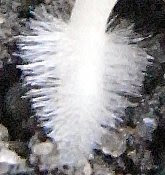
root hairsWater enters plant roots (along a concentration gradient) through fine root hairs (see 'Apoplast And Symplast Pathways In Root A Hair') then makes its way across the root tissues (cortex, endodermis and pericycle (see 'Cross Section Of Young Dicot Root') towards the xylem, that part of the vascular system which distributes water and dissolved mineral salts throughout the plant.


THREE ROUTES OF TRAVEL

Water may travel across the root by one of three pathways:
  • apoplast - within cell walls only (unselective)
  • symplast - in cytoplasm, through plasmodesmata (selective)
  • cell-to-cell (transmembrane pathway) - through vacuoles of each cell (selective)
3 routes water can take in cellsWe have seen that a typical cell comprises an outer cell wall surrounding a partly permeable plasma membrane, enclosing cytoplasm and inner vacuole. We have also seen that the cytoplasm of adjacent cells is connected through 'gaps' in the cell wall called plasmodesmata.

APOPLAST PATHWAY
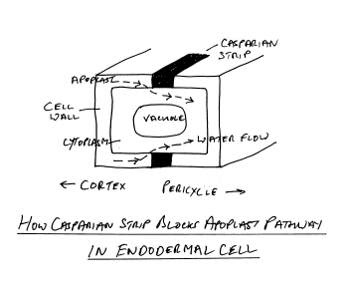
If once water enters the root hair, it travels from cell to cell, across the cortex, in the CELL WALLS ONLY, it is said to take the 'APOPLAST' pathway. Because cellulose is pervious and non-selective, both water and ALL dissolved minerals may be carried this way. Note that the plasma membrane (separates cell wall from cytoplasm) need not be crossed, not until the endodermis - a defensive ring of cells, one cell deep - is reached. So OSMOSIS need not be involved up to this point, only diffusion.how Casparian strip blocks apoplast in endodermal cellCasparian strip surrounding endodermal cellAt this point, the impervious Casparian strip blocks progress and forces both the water and mineral salts to cross the plasma membrane into the cytoplasm, where they can continue on the symplast pathway. However, not all mineral salts make it - the plasma membrane is selective and can filter out unwanted solutes.


SYMPLAST PATHWAY
If water passes from the cell wall through the plasma membrane to the cytoplasm, it can then travel from cell to cell through the plasmodesmata in the cell walls. This is called the 'SYMPLAST' pathway. Note that the plasma membrane, because it is partly permeable, can only be crossed passively by OSMOSIS. Passage of dissolved nutrients, because their molecules are too large, are blocked and cannot pass passively; they must cross the plasma membrane into the cytoplasm by active transport, a selective process; osmosis is not involved.

CELL TO CELL
Water can also enter the vacuoles (which are within the cytoplasm), then pass from vacuole to vacuole. This is called the 'CELL TO CELL' or 'TRANS MEMBRANE' pathway.

POINT OF INTEREST
It is commonly supposed that both water and minerals enter the plant cytoplasm as one process. They don't. Each enters independantly of the other; mineral salts can enter a plant even when no water is being absorbed. However, once inside the cytoplasm, minerals travel in solution.

TOXIC VEGETABLES
Although the endodermis prevents toxins and any other unwanted solutes from entering the stele of the plant, and hence travelling to the stems, leaves and fruits, these nasties may be present in the epidermis and cortex of the plant, taken in through the unselective apoplastic pathway. Since the cortex represents the bulky 'food' part of roots, we need to be extremely careful.

8 July 2011

Potato Update

After bringing potted potato plant back to wilting point to ensure the lower soil was dry enough, I added a layer damp soil to surface to see if surface roots could extract enough water for recovery. Because plant was still wilting one day later, I got nervous of plasmolysis and sprayed new soil with water so dampness went down about 6mm (1/4 inch). Plant started to recover.

If you remember, the last time I tried to damp just the surface, the result was the same. So it looks as if the tiny roots right beneath the surface (this doesn't seem likely) do not take in water and plant uses roots a little lower down (still in top 6 mm). Of course, it might just be that I didn't give roots long enough.

No sign yet of any roots growing into new soil. Will keep it damp and see what happens.

1 July 2011

Surface Potato Roots Do Seem To Absorb Water

wilting potato leavesThese wilting leaves on the potted potato plant indicate it is short of water. Good. I took the opportunity to test if the surface roots, described recently, will in fact take in water.

So, lightly sprayed surface with clean water . . . Nothing at first, even after 8 hours . . . But once water got down a quarter inch (6mm) or so, the plant did start to recover. I don't think much water got further down than this, but cannot be absolutely certain. Of course, I have no control. But it still gives some indication of the value of the surface roots in gathering rain showers.

Am letting plant reach wilting point again, then covering surface roots with damp garden soil to see what happens.

Cross Section Of Young Dicot Root

cross-section of young dicot rootThis is a typical cross-section of a young dicot root taken in the region of root hair proliferation (see 'Plant Root Growth'), before lateral secondary growth has begun. Hence, the lateral meristematic tissue (cambium) is not yet present.

EPIDERMIS - Developed from the protoderm, it forms a cover, one cell thick, around the root's perimeter. In the region just back from the root tip, cells produce extensions as root hairs to increase the root's water-absorbing potential.

CORTEX - Developed from the ground meristem, these are typical 'fleshy' parenchyma cells with thin walls, large vacuoles and air spaces between cells, facilitating storage of food and water.

In roots of some plants (bog-type plants), some of the cortex cells are lost, producing even more air spaces 'aerenchyma', which allow gases to diffuse WITHIN the plant to and from the root tips.

ENDODERMIS - Surrounds the vascular tissue and can be seen as the innermost layer of the cortex. Unlike the epidermis, each cell wall contains a vertical ring of fatty suberin, called the 'Casparian Strip', making the wall impervious and thus keeping out unwanted solutes.

PERICYCLE - A layer one to several cells thick, between vascular tissue and endodermis. This is modified parenchyma which retains its capacity for cell division and produces the lateral roots which then punch their way out through the outer tissues.

VASCULAR TISSUES - PHLOEM AND XYLEM form an inner stele through the centre of the root, right up to the hypocotyl, where the root joins the stem. The structure then changes into that of a typical stem.

17 June 2011

Tomato Surface Roots

tomato surface roots now formedAfter carefully scraping beneath compost surface, I found this root about 2cm (3/4 inch) down. Didn't want to disturb it more than necessary, so could not tell if it had come up from below or had grown from top of stem (seems more likely). Still, it means things are still going to plan - a miracle in itself.

Will continue with light waterings (1 pint per gallon of compost) when top of compost just starts to change colour. Should encourage good root system.

tomato flowersAlthough there's a truss of flowers forming, these are not yet open. Will only step up watering and begin feeding once first tomatoes have set and are about pea-size.

Hopefully things will speed up with recent warmer weather.

Potato Surface Root Proliferation

potato surface root proliferationOver the past week or so, fine curly roots have proliferated just beneath soil surface (some are ringed red). However, it's not clear where these are originating. And this activity seems to be mostly above troughs in main root wave. But where main root comes closer to surface, there is little sign of it (right). Although these new roots are clearly visible through side of pot, they cannot be seen from above. i.e. they do not seem to penetrate soil surface.

PURPOSE OF ROOTS
no roots at crest of potato rootNot sure what purpose these roots serve, but presumably they gather water from light rain showers, which hardly penetrates into soil. Should think they can also extract condensation formed overnight at soil surface from water vapour rising from below. Probably quite a lot of water to be had this way.

Had no idea potatoes were so efficient at extracting water (if that's what these roots are for). But concerned about:
  • what happens if surface dries out - do roots survive and remain effective?
  • what happens when roots disturbed by surface weed control - how quickly do they re-grow, if at all?
  • what happens when potatoes earthed up - how quickly can they reach new surface?
  • do they make mulching less effective (not so much in potatoes but in other crops)?
  • implications for top dressing

WHEN SURFACE DRIES OUT
Very few commercial soils have constantly damp surfaces. Are these roots damaged by drying? Presumably not - not if their purpose is to harvest rare showers in dry soil.

WEED CONTROL
Surface hoeing could be a real problem and present much damage, at least in the short term. But most of weed control in potato drills is done by covering small weeds during 'earthing up' process. Would seem essential not to let weeds get too large to be covered this way.

MULCHING - IS IT ALWAYS EFFECTIVE?
Because mulching materials tend to be coarser than soil, it's likely these roots cannot proliferate to same extent, if at all, perhaps leaving a dry barrier between soil surface and atmosphere - one which light rain showers could not penetrate.

As already outlined, if the top couple of centimetres (inch) or so of soil surface is loosened by cultivation it forms a natural barrier (mulch) to water loss (see posts on weeding and water conservation). Therefore, all mulching really does is delay the drying process; it is probably not much more effective than the soil's own natural mulch (formed when loosened surface insulates and reduces loss due to wicking). Bearing in mind surface roots, we need to ask the question: 'Are there are circumstances where mulching might be ineffective?'

TOP DRESSING
It's always assumed feeds need working into surface. Might do more harm than good.

Any views about all of this?

Coriander Severed Roots After 11 Days

new coriander rootsThese brand new roots, complete with root caps, have appeared sooner than expected (see 'Coriander 'Multi-Plant' Matted Root Trim').

Plant has been kept un-watered, at about 17 deg C, indoors and in good light. Compost still quite moist, so should not need watering for perhaps another week (provided it remains indoors); it's just about at right stage for root and foliage growth right now.

coriander flowers on multi-plant in plastic cupFlowers seem to be developing quite well, for now. Newer growth looks fresh and healthy. Not sure if stems are becoming wavy (below)? Wait and see . . ..
wavy coriander stems?

10 June 2011

Coriander 'Multi-Plant' Matted Root Trim

coriander matted roots at base of multi-plant cupThese matted coriander roots are on a plant from a 200ml plastic cup found under bench. Discarded when it began going to seed, it has not been watered for some time. Compost was virtually bone dry and foliage had almost - but not quite - gone. Original intention was to confirm Ken Pilkington's findings that 'Multi-Plant' (his name for a plant community in a pot) roots remain fine and fibrous, not thick and tap-root-like.

coriander matter roots removedAfter severing and removing matted base roots, plant was placed in a 4.5 inch pot of plain compost to same depth it was in 2.5 inch cup. Note how much inner compost is unused. Idea is to utilize this as well as new compost.

coriander after potting upI know photo is not very good, but a few flowers already forming on stems in pot. Should be interesting to see if it will revive (plants do not usually thrive if they have suffered a severe setback) and how efficiently it can produce flowers. I think a 'Multi-Plant' has great potential in this area (certainly has in the fuchsia area), capable of easily producing many flowers and seeds on relatively compact, stable plants.

Potato Laterals Not Just At Surface

more potato lateralsJust after stating that 'potato laterals are mostly at surface' of the half litre plastic cup (see 'Why Are Potato Lateral Roots Mostly At Surface?'), more have appeared further down. These new laterals also at 'crest' of 'root wave' with little in gullies either side (this photo actually shows two roots, but seems to illustrate the point). Only this time new lateral growth is mostly upward and is more extensive. It is also comprised of only the finer roots, at the moment, though these possess root hairs, so might thicken up to be like those described last week.

THESE LATERALS NOT ON ROOT AT SURFACE
Far from being just beneath the surface, this root is nearly two thirds way down the cup. And it is unlikely that this part of the cup has been watered in the same way as the surface. This might indicate:
  • perhaps potato roots grow in a wave fashion wherever they are, independent of soil water levels
  • perhaps laterals at crest of roots are not responding to being near soil surface
IMPLICATIONS FOR GROWERS
It seems amazing that roots actually grow so close to the soil surface. This means that any sort of mechanical weeding is certain to damage them and impair the plant's ability to take up water.

Do Dahlia Roots Come So Close?
Dahlia feeder roots also come up to the surface. I wonder if they also come so close?

NO RESPONSE TO SYRINGE WATER
Still early days, but water applied by syringe to gully of root at top of cup does not seem to have produced a response, perhaps indicating laterals are not produced in response to moisture levels. Seems unlikely.

Advantages Of Storing Begonia Tubers As Root Balls

begonia tuber root ballMany begonia growers brush their tubers off before storage. I have never had much luck with this method. I always store mine as a root ball complete with soil or compost, and find it has advantages.

ADVANTAGES FOR STORING
Although I stop watering my begonias in pots around the start of October, I still find they do not really dry out. Consequently, it is for me almost impossible to clean them without breaking the tubers or damaging them in some way. So I just place them in an airy spot to dry them as much as possible before storage, then don't cover until the really severe weather comes. They seem to store well this way with little or no disease problems. We covered lifting begonias last year.

ADVANTAGES FOR PLANTING
Once it becomes clear in early spring that tubers are showing signs of growth, root balls can be watered lightly and placed in a light frost-free place. This helps them along and avoids the need to pot up the larger tubers which are almost impossible to fit into almost any pot.

'Provaso Vine Weevil Killer'BEWARE OF VINE WEEVIL GRUBS
The tuber above has been treated as described and can now be planted as it is. However, it will need some treatment for vine weevil grubs which will almost certainly have overwintered with the tubers and will be hiding in the roots somewhere. I use 'Provado Vine Weevil Killer', a stronger dose of thiacloprid.

6 June 2011

Leggy Tomato Plant First Watering

Gave a pint of water to tomato plant in gallon pot today. Don't want to give too much till roots come up to surface. Recent rains have helped but not enough. Compost dry down to 5cm (2 inches). i.e. no water visible when squeezed between thumb and forefinger; plant been going limp in hot sun, but recovering overnight.

Foliage now darker in colour, so roots have found new compost after re-pot. Plant seems to be growing quite well, so far. First truss now has some unopened flowers.

3 June 2011

Why Are There Two Types Of Potato 'Lateral Roots'?

TWO TYPES OF 'ROOTS'

two types of laterals at surfaceSomething else interesting about the new laterals developing from the potato root we saw last week are the two apparently different types of 'root': thick ones (pink) and thin ones. Are they both roots or just the thicker ones with the root hairs? Can't see how they could be tuber* rhizomes, since these arise from stems. I know adventitious roots also come from stems. But not from the same source, surely. But the two types seem to be attached to the parent at different angles.

Too soon to determine any of this. Not even clear whether each of these types of 'root' is attached to the main root. See what develops.

* A potato tuber is a bulky short terminal part of an underground stem (rhizome) whose 'eyes' are really buds at nodes. Shoots and roots grow from these eyes upon planting. We often see these on old potatoes in the cupboard which have started to grow. The main bud is at the end of the tuber and exerts dominance over the other lesser 'eyes' in the way expected in stem terminal buds.

Why Are Potato Lateral Roots Mostly At Surface?

potato lateral roots mostly at surfaceThis is the same root you saw last week, rising and falling beneath the soil surface. More interesting developments this week:

Secondary (lateral) roots have suddenly developed, but only where the original root is nearest to the surface. It's hard to get a photo because of the shape of the pot, but the root is almost devoid of laterals either side where it is lower in the soil, so farther away from the surface. Why?
  • Perhaps laterals responding belatedly (it takes lateral roots some time to appear, because they have to grow from the 'pericycle', deep inside the root) to the water applied to the surface some time back.
  • or Perhaps, being principally feeder roots, they just grow when roots come up near the surface (feeder roots do this to gather water from rain showers, among other things)
soil moistened with a syringeJust out of interest, I inserted some water around the lower root (where it is furthest from the surface) with a syringe, so that the soil is just moist. Will this water induce lateral roots to form?