August in the UK is a difficult month for fuchsias. If the hot muggy weather doesn't allow botrytis to destroy plants, the sudden appearance of dark thundery skies followed by prolonged warm dull days produces long (leggy) growth through etiolation.
PROBLEMS INDOORS WITH CONTAINED AIR
Things are not so bad OUTDOORS where darkening skies (loss of sun) do lower temperatures more quickly. No. It's INDOORS where problems really occur. Contained air (either by walls or glass) does not cool down nearly quickly enough to accommodate reduced light; the plants 'assume' they have competition, so therefore need a sudden spurt of growth to outgrow this. Hence leggy plants.
Etiolation is caused by elongation of the stem's vertical cell walls, controlled by the growth hormones 'gibberellins'
Showing posts with label Light. Show all posts
Showing posts with label Light. Show all posts
5 August 2011


15 July 2011
Shading Plastic Cups Seems To Improve Growth
 It's been a poor year for fuchsias as far as I'm concerned. They just haven't grown. At least not for long periods. Then they have. Fits and starts the whole time. And the growth spurts seem to have coincided with warmer weather. This is strange, since fuchsias grow well in cool conditions (about 10 deg C (50 deg F)).
I had this great idea to grow cuttings in 200ml plastic cups because, being deep with low surface area, they seemed to offer great potential. But their greatest feature was that I could actually see the roots growing and how the plants were using water in the compost. It all seemed so ideal, just as lots of my ideas do at the time.
Alas, things did not turn out as planned. Whilst growing well in early spring, they suddenly stopped and hardly moved at all. After deducing this was because the compost was getting too warm in the strengthening sun, I popped the cup into a 3.5 inch plant pot to keep it cool. And guess what? They started growing.
Furthermore, I have also noticed that cuttings rooted in the centre of a perlite cup do so more quickly than those around the edge. This time I convinced myself it was somehow cooler in centre - another act of near lunacy when seen in the clear light of day.
Anyway, I read an article in the 'Science Daily Blog' last week (first published in December, 2008) which outlined that plant roots have a sensing mechanism to detect UV-B light levels. They then send signals which cause the plant to adjust its normal growth appropriately. I'm not sure exactly how this works, or in what way growth is adjusted. But it could nevertheless offer an explanation for fuchsia cutting growth: Perhaps it was the increased light intensity, not the temperature, which caused growth to slow down in both the compost and in the perlite. Still not sure, though. It could just as well be 'something in the air'.
24 June 2011
White Patches On Geranium Leaves
 Had I not seen it with my own eyes, I never would have believed geraniums (pelargoniums) could catch sunburn (sun scorch). Apparently so. This raises an interesting question; what has happened to the thick cuticle (see 'Plant tissues') which protects against the sun?
Kept in low light conditions for a long time, the plant will have adapted itself to these - probably reducing (or even almost removing) its waxy cuticle (sun and water-loss protection). It would be interesting to confirm this by taking a leaf section and viewing under a magnification. I say this because leaf size has also increased in low light (leaves do this, and vice versa). It might be that the cuticle is still in tact, but the plant has itself jettisoned some chlorophyll and perhaps mesophyll tissue for reasons best known only to itself. In other words, this reaction is the plant's way of reducing its leaf area.
17 June 2011
Sun Scorch (Sunburn) On Begonia Leaf
 This is sun scorch (sunburn) on a begonia leaf, common at this time of year (midsummer) when moving plants too quickly from shade into strong sunlight.
Although plants are classified according to their light preferences - e.g. shade-loving; sun-loving etc - this is not absolute. We saw last year that, given time, plants can adjust to almost any environment (see posts on 'light').
PLANTS TAKE IMMEDIATE AVOIDING ACTION
Although begonias do not seem to be able to do this very well, plants can often react quickly by altering leaf turgo pressure (there are different ways of doing this), causing them to either follow or avoid the sunlight. For example, begonias (shade-loving plants) flute their leaves (common with many plants).
LONG-TERM ACTION TAKES TIME
However, they also GROW into their new environment and develop a thick waxy cuticle on the leaf surfaces to protect against damaging ultra violet rays; leaf size is also reduced in bright sunlight, and vice versa.
REMEDY
Leaf structural damage is permanent; they will not recover. However, if the disfigurement can be tolerated in the short term, it is worth leaving the damaged leaves in position because:
- there will usually be some undamaged tissue left which will speed growth of new leaves
- they offer shade to young tender leaves
20 May 2011
Feathery Coriander Leaves

When coriander leaves become deeply fissured and take on a feathery appearance, the plants are running to seed. Although still edible, they become bitter. This happens from this time through till August in the UK.
I am not sure what causes this. Some say it's the hot weather. But I don't think it is. Coriander seems to grow normally during hot Augusts. So it could be caused by shorter summer nights (i.e. it's a 'photoperiodic' response (induced by daylength)).
Photoperiodism is common in plants in temperate regions where seasonal climatic differences exist; but I don't think it's so common in Mediterranean plants, as I think coriander is. I could do with some advice on this.
Plants constantly manage daylength using phytochrome in their leaves. Their many activities never cease to amaze me.
14 May 2011
Dahlias Started In Trays Are Short-Jointed
 This dahlia tuber hasn't grown much since planting in soil in a seed tray nearly two months ago. I believe this to be good news. Can I explain:
It's not how MUCH it has grown, but the TYPE OF GROWTH it has made, which is important. Keeping cool, in good light, and restricting water and space has produced a miniature plant - one that is far more short-jointed than traditional dahlias started early in pots, especially if heat has been applied.
So what? Why is this important? Surely we want the plant to get big as soon as possible, don't we? And what does it matter how short-jointed a plant is if it is to be buried in a hole?
Well, I think it matters quite a lot. As you can see, there are at least three nodes within the first 2.5 inches (7 cm) of shoot. And because the soil in the tray is shallower than a pot, this sets the plant lower in the ground . . . And because the nodes are so low, they will be even deeper in the ground where there should be even more moisture . . . And because each node can produce an additional set of adventitious roots, we should have some great growth potential . . . And because each node should produce two new shoots, we should get more flowers . . . And because the shoots are coming from below ground, the plant should be more compact and more stable, so should not need staking. The advantages seem almost endless. The only problem is that there's a lot of catching up to do - it's that 'tortoise and hare' thing again. Will there be enough time left in the season? Let's hope so.
See also:
Producing Drought-Resistant Dahlias In Shallow Soil
How Geotropism Can Build Drought-Resistance In Dahlias
14 April 2011
Dahlias Need Stronger Light
Thought they'd never wake up - the dahlias. Now they have and there's nowhere to put them; the spring bulbs haven't yet finished. Problems. Problems.
 These tubers in tray now have shoots which need stronger light. They need putting outside. No problem. Just move outside. Can be left out. But beware of slugs and frost.
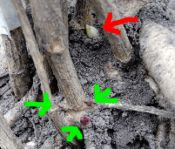 The tubers we awakened with water have also produced new shoot buds, though not as large as in the trays. They have also just started to grow new roots (below).
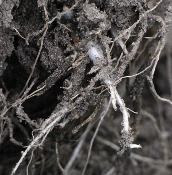 It's always best - with all plants - not to disturb the roots too much. So these tubers need putting in the soil before their roots get tangled. But can't do this yet. So. Compromise. Stand clumps on soil surface next to spring bulbs. This way, they keep growing, producing strong short growth. Again, watch out for slugs and frost. Roots will grow down into soil a bit, but not into other plants - and they shouldn't be there long.
BEST TIME FOR DIVISION
If you want to increase your stock, now is a really good time to divide them. Get a sharp knife or spade and cut between the buds and down through the tubers, so that each half has bud(s), a stem(s) and at least a bit of tuber attached. Take care not to damage the buds. Each bud will produce a new stem. So you can determine the size of each new plant. The further you split them (i.e. down to a single bud with stem and piece of tuber), the stronger they will grow. You won't get as many flowers - although these will be larger.
TUBERS IN TRAYS AND POTS
 These tubers in tray now have shoots which need stronger light. They need putting outside. No problem. Just move outside. Can be left out. But beware of slugs and frost.
AWAKENED DAHLIA TUBERS
 The tubers we awakened with water have also produced new shoot buds, though not as large as in the trays. They have also just started to grow new roots (below).
 It's always best - with all plants - not to disturb the roots too much. So these tubers need putting in the soil before their roots get tangled. But can't do this yet. So. Compromise. Stand clumps on soil surface next to spring bulbs. This way, they keep growing, producing strong short growth. Again, watch out for slugs and frost. Roots will grow down into soil a bit, but not into other plants - and they shouldn't be there long.
BEST TIME FOR DIVISION
If you want to increase your stock, now is a really good time to divide them. Get a sharp knife or spade and cut between the buds and down through the tubers, so that each half has bud(s), a stem(s) and at least a bit of tuber attached. Take care not to damage the buds. Each bud will produce a new stem. So you can determine the size of each new plant. The further you split them (i.e. down to a single bud with stem and piece of tuber), the stronger they will grow. You won't get as many flowers - although these will be larger.
10 March 2011
Avoid Stretching Young Plants
After nurturing the fuchsia cuttings all through the winter, I am left with compact plants. Now, as temperatures start to rise, especially when the days are dull, there is a risk of losing all this work. Etiolation (stretching towards the light, producing thin, leggy growth) usually occurs overnight. And once it occurs there is no way back. For this reason, many serious growers keep their plants outside.
 But things are not so easy with young tender plants - these need to be first hardened off (acclimatised). This half-tray propagator, complete with a ventilated lid, is a way of protecting up to 9 cuttings in 2 inch (51mm) pots against the chilly winds. It allows cuttings to get maximum light at minimum temps.
However, care must be taken to keep the propagator out of the sun to keep temperatures as low as possible and avoid scorching the young leaves. A sunless spot might look like shade to us, but it's paradise to a fuchsia, especially on a bright, cloudless day.
 But things are not so easy with young tender plants - these need to be first hardened off (acclimatised). This half-tray propagator, complete with a ventilated lid, is a way of protecting up to 9 cuttings in 2 inch (51mm) pots against the chilly winds. It allows cuttings to get maximum light at minimum temps.
However, care must be taken to keep the propagator out of the sun to keep temperatures as low as possible and avoid scorching the young leaves. A sunless spot might look like shade to us, but it's paradise to a fuchsia, especially on a bright, cloudless day.
20 January 2011
Frosty Weather Best For Growing In January
Thank goodness the recent dull warmer days seem to be behind us. They have played havoc with the fuchsias, creating leggy growth. This is not too good if the object is to produce compact short-jointed plants. Frosty weather, caused by clear skies, definitely produces the best light for growing in January. And the cold should kill off a few slugs which have hatched out in the milder weather.
The sun is producing more heat now and can be readily felt behind glass. The growing season will soon be in full swing.
The sun is producing more heat now and can be readily felt behind glass. The growing season will soon be in full swing.
6 January 2011
Coriander Canary Detects Low Light
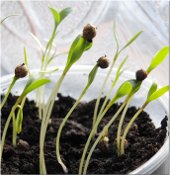 All seedlings will etiolate (stretch) if the light intensity is too low. The coriander here is no exception. I have been germinating seeds at room temperature (a cool room), then cooling down to 7 to 8 deg C (44 to 46 deg F) during December (see growing coriander notes).
 As you can see from this photo, things were going fine until last week when the mild foggy weather reduced light levels and increased temperatures to 10 deg C (50 deg F). The etiolation (shown above) happened overnight.
This tells me three things:
- coriander will actually grow at low temperatures - far lower than I expected
- most of the winter light is acceptable at these temperatures - it is just the odd fluky day (fog and heat) that can cause problems
- it is still too early to plant most seeds - best wait till the light improves
The etiolated seedlings will still develop and will not be wasted. So it is worth planting a few seeds, just to be sure of adequate light levels.
P.S. I would love to know what fungus is growing on the compost. It doesn't seem to affect the coriander.
14 December 2010
Should Geranium Shoot Growth Dictate Pruning?
 I hope you can make out the strong new shoots which have grown from the collapsed stems (due to growing too fast) of this geranium. The point here is they have grown in the gap without any encouragement (the stem has not been cut back), almost certainly because the spot has received unrestricted sunlight; nodes further up the stems, which are in the shade because they are behind other stems, have not developed. This looks like phytochrome at work again.
Of course, it could just be coincidence. And, strangely, I have never before noticed such a response. But if new shoots have a preference for non-shade, then it will pay to prune accordingly. In other words, the plant can be pruned into a conical rather than a mushroom shape, thus helping ensure all new buds are free from shade.
Note that when a stem collapses into a horizontal position, the dominant effect of the apical bud is removed and the axillary buds lower down the stem are able to develop (they were previously restricted by auxin produced by the apical bud) into several upwardly-growing new shoots. This effect can often be seen on fallen trees which still have some roots left in tact.
Going Back to Basil. Are Low Energy Lights the Problem?
It's been bothering me all year. I don't like failure, at the best of times. And to fail at the first hurdle . . . Well! But those who have read the early posts know this is just what happened - the very first seeds (basil) failed to germinate, and I wasn't really able to give a satisfactory explanation (I put it down to temperature). Now, after reading something more about the effects of light quality on lettuce seed germination, I have had a re-think. I don't know why I never saw it before. Basil might also need a light stimulus to germinate.
The seeds were placed near a low-energy fluorescent bulb, so were probably low in essential orange-red (660nm) light. This seems especially apt since basil comes from a part of the world where natural light contains much light of this wavelength.
The more I think about this explanation, the more it makes sense. Although the propagator was warmer than the original position, it was also in stronger natural light.
Note that phytochrome stimulation does not need strong light, as does photosynthesis. A low wattage tungsten bulb is effective.
The seeds were placed near a low-energy fluorescent bulb, so were probably low in essential orange-red (660nm) light. This seems especially apt since basil comes from a part of the world where natural light contains much light of this wavelength.
The more I think about this explanation, the more it makes sense. Although the propagator was warmer than the original position, it was also in stronger natural light.
Note that phytochrome stimulation does not need strong light, as does photosynthesis. A low wattage tungsten bulb is effective.
Don't Confuse 'Phytochrome' with 'Photosynthesis'
I realise that all this talk about phyto-this and phyto-that might be more than a little confusing, especially if you have no previous knowledge of biology. I would really like to go through it all and explain it to you (at least as far as I understand it), but it takes up an awful lot of space.
Although this blog is about growing plants successfully, I feel that a deeper knowledge of how plants operate is not just USEFUL but ESSENTIAL in achieving this. Of course, you don't need to absorb every detail, but I think it's good to know where things are coming from. And you can always do some of your own research - there's loads of readable information on the Internet. Even though some of this could present a more accurate picture, by selecting those web pages you can get on with, you can learn more about plants and how they grow. Don't try to take it all in; just have a look; it will all make sense eventually.
By the way, Phytochrome is a blue PIGMENT which the plant uses as a photoreceptor with which it can determine light quality and also probably day length. Photosynthesis, on the other hand, is a PROCESS - one in which a plant uses green chlorophyll to manufacture the sugar glucose.
Although this blog is about growing plants successfully, I feel that a deeper knowledge of how plants operate is not just USEFUL but ESSENTIAL in achieving this. Of course, you don't need to absorb every detail, but I think it's good to know where things are coming from. And you can always do some of your own research - there's loads of readable information on the Internet. Even though some of this could present a more accurate picture, by selecting those web pages you can get on with, you can learn more about plants and how they grow. Don't try to take it all in; just have a look; it will all make sense eventually.
By the way, Phytochrome is a blue PIGMENT which the plant uses as a photoreceptor with which it can determine light quality and also probably day length. Photosynthesis, on the other hand, is a PROCESS - one in which a plant uses green chlorophyll to manufacture the sugar glucose.
7 December 2010
Should We Dig in the Dark?
I know the ground is frozen solid, but for those of you with some digging still to do in weedy soil, here's something to consider:
As mentioned elsewhere, many seeds are sensitive to the quality of light for germination; this helps them grow in ideal positions. Some species require an open site; others prefer company. By assessing the quality of light (i.e. its constitution), they are able to determine their position.
How do they do this? They use a pigment called 'phytochrome', which is capable of determining the proportions of red and far-red light available. Leaves filter out red light whilst far-red is filtered much less, hence decreasing the red:far-red ratio. Those seeds requiring an open position germinate when there is a high proportion of red light available, and vice versa.
Many garden weeds germinate following light stimulation, often for just a few seconds. Digging in the dark would deprive exposed red-light-requiring weed seeds of this stimulus and hence hence reduce germination up to four-fold (since they would have the impression that they had landed in shade).
Before you rush for the spade handle and the flashlight, please bear in mind that this is only an idea, not - I think - one to be taken too seriously. . . although I don't know . . .?
As mentioned elsewhere, many seeds are sensitive to the quality of light for germination; this helps them grow in ideal positions. Some species require an open site; others prefer company. By assessing the quality of light (i.e. its constitution), they are able to determine their position.
How do they do this? They use a pigment called 'phytochrome', which is capable of determining the proportions of red and far-red light available. Leaves filter out red light whilst far-red is filtered much less, hence decreasing the red:far-red ratio. Those seeds requiring an open position germinate when there is a high proportion of red light available, and vice versa.
Many garden weeds germinate following light stimulation, often for just a few seconds. Digging in the dark would deprive exposed red-light-requiring weed seeds of this stimulus and hence hence reduce germination up to four-fold (since they would have the impression that they had landed in shade).
Before you rush for the spade handle and the flashlight, please bear in mind that this is only an idea, not - I think - one to be taken too seriously. . . although I don't know . . .?
23 November 2010
Don't Paint It Green

If you're thinking of giving your growing area a bit of a face lift some time soon, can I give you some advice: Don't paint it green. As you can see from this approximation of the absorption spectrum of chlorophyll 'a' (it shows how much of each colour the plant can use), plants use hardly any green light, tending to use light from the blue and red ends of the spectrum for photosynthesis.
I remember thinking it such a good idea to paint my rear porch green, only to discover much later this was why the plants weren't prospering - not the poor season which subsequently followed. It never occurred to me that plants are not really green: they only appear green because the chlorophyll (and other pigments) has absorbed all the other colours from the visible spectrum, leaving just the green light (or whatever an object appears to be) to be reflected to our eyes.
I find white the best colour for a growing room, especially this time of year when plants benefit from as much reflected light as possible. You can even use tin foil in the winter, though it tends to be too much when the sun gets stronger. Like we humans, plants can also suffer sunburn.
1 September 2010
Getting the Light Right - Part 3
Choosing the Window Sill
Window sills make ideal growing platforms, provided a few things are considered:
It takes a very brave plant to face the world on a south-facing sill, especially from late spring onwards when the sun is becoming strong. Only pot geraniums, of the pot plants I possess, are able to withstand the intense heat and low humidity; they are adapted to do this. Nevertheless, even these plants suffer in mid-summer - they too would prefer some shade during these days.
Conversely, few plants can tolerate the low winter light levels of a north-facing sill. I find this position ideally suited to cyclamens, especially in a cooler room. North-facing sills are better if they receive some morning and evening sun. This greatly increases their usefulness.
Both east and west-facing sills are good and will each accommodate a wide range of plants.
Turn the plants daily
The only problem with window sills is that the light is uni-directional, so plants always grow towards it. For this reason, they need turning either each or every other day to keep them growing upright. However, provided this is done, things are fine.
Humidity
Radiators positioned beneath windows should be turned down if we wish to grow plants near them because they lower humidity levels too much, thus drying the plants. Since plants develop stronger at lower temperatures, it might be best to turn off the radiator completely.
Temperature
In winter, it is important that delicate plants are not left too near to the glass when it is freezing outside. Leaving the curtains open is a big help here, since temperatures can drop rapidly after dark behind heavy curtains.
Window sills make ideal spots for small propagators, which can be used to get seeds and cuttings off to an early start. But it is necessary to watch out for the sun. Cover with fleece or half-thickness kitchen roll, so the plants get light but not heat.
Window sills make ideal growing platforms, provided a few things are considered:
- Light
- Humidity
- Temperature
It takes a very brave plant to face the world on a south-facing sill, especially from late spring onwards when the sun is becoming strong. Only pot geraniums, of the pot plants I possess, are able to withstand the intense heat and low humidity; they are adapted to do this. Nevertheless, even these plants suffer in mid-summer - they too would prefer some shade during these days.
Conversely, few plants can tolerate the low winter light levels of a north-facing sill. I find this position ideally suited to cyclamens, especially in a cooler room. North-facing sills are better if they receive some morning and evening sun. This greatly increases their usefulness.
Both east and west-facing sills are good and will each accommodate a wide range of plants.
Turn the plants daily
The only problem with window sills is that the light is uni-directional, so plants always grow towards it. For this reason, they need turning either each or every other day to keep them growing upright. However, provided this is done, things are fine.
Humidity
Radiators positioned beneath windows should be turned down if we wish to grow plants near them because they lower humidity levels too much, thus drying the plants. Since plants develop stronger at lower temperatures, it might be best to turn off the radiator completely.
Temperature
In winter, it is important that delicate plants are not left too near to the glass when it is freezing outside. Leaving the curtains open is a big help here, since temperatures can drop rapidly after dark behind heavy curtains.
Window sills make ideal spots for small propagators, which can be used to get seeds and cuttings off to an early start. But it is necessary to watch out for the sun. Cover with fleece or half-thickness kitchen roll, so the plants get light but not heat.
21 August 2010
Getting the Light Right - Part 2
How We Determine a Plant's True Light Requirements
Although our plants are in roughly the right position (we hope), how do we really know?
Simple. We watch them - they 'communicate'. They move themselves around until the light fits just right, just as we do on the beach. This movement is called 'phototropism'.
LEAF MOVEMENT
If light is too LOW
 This mint has gone leggy (become etiolated, stretching vertically) and is also bending towards the light. It is thus clearly asking for more light.
Plants also grow larger leaves in low light; it helps them produce enough food. This is why it is best to keep coriander leaf (cilantro) out of too bright light.
If light is too HIGH
 We have already seen how a begonia turns its leaves away from the sun. This fuchsia is doing the same thing. I'm not sure if you can see, but the leaves are all different sizes, reflecting to some extent the different light levels to which it has been exposed.
ROOT MOVEMENT
Roots exhibit negative phototropism. That is, they move away from the light. You would have seen this with your coriander roots, although I didn't mention it at the time.
Although our plants are in roughly the right position (we hope), how do we really know?
Simple. We watch them - they 'communicate'. They move themselves around until the light fits just right, just as we do on the beach. This movement is called 'phototropism'.
LEAF MOVEMENT
If light is too LOW
 This mint has gone leggy (become etiolated, stretching vertically) and is also bending towards the light. It is thus clearly asking for more light.
Plants also grow larger leaves in low light; it helps them produce enough food. This is why it is best to keep coriander leaf (cilantro) out of too bright light.
If light is too HIGH
 We have already seen how a begonia turns its leaves away from the sun. This fuchsia is doing the same thing. I'm not sure if you can see, but the leaves are all different sizes, reflecting to some extent the different light levels to which it has been exposed.
ROOT MOVEMENT
Roots exhibit negative phototropism. That is, they move away from the light. You would have seen this with your coriander roots, although I didn't mention it at the time.
It's All About Light
Green plants cannot function without light. They need it for photosynthesis, the process by which glucose is created from water and carbon dioxide. This simple sugar glucose can then be eventually combined with nitrogen ions to create amino acids, the building blocks for proteins.
So photosynthesis is the dynamo which allows the plant to function and grow. Although artificial light (but not really tungsten, or household light) can be used, the principal source is SUNLIGHT. This is important to the plant in two ways:
So photosynthesis is the dynamo which allows the plant to function and grow. Although artificial light (but not really tungsten, or household light) can be used, the principal source is SUNLIGHT. This is important to the plant in two ways:
- It's INTENSITY affects the rate a plant can grow (assuming no other essential factor is limited)
- It's LENGTH (the length of day, or photoperiod) can affect reproduction (time of seed germination, flowering, food storage, and senescence (death))
18 August 2010
Getting the Light Right - Part 1
Plant Labels Only A Guide
At one time, assessing a plant's environmental requirements used to be some sort of arcane art known only to the few. Not any more. Nurseries have obliged by providing cultural information with their plants (it's in their interests that we keep them alive). Labels tell us everything we need to know: How much water and light they require, what type of soil, and often much more. How can we go wrong (do I really have to ask?)?
Well, apart from the fact that most people don't even read the labels - or do read them but ignore what they say because they inform them the plants are completely unsuited to their chosen location - things never seem to work out how we thought they would (do they ever?). Very seldom can we accommodate a plant's exact requirements.
Also, many find labels confusing. Half a sun (those arcane arts again) might not mean much to Great Aunt Bertha who remembers how the gardener seemed to make things so simple to her childish mind . . . she just wants it in plain English like it used to be.
And does it really matter if we only have a quarter of a sun and not a half? Probably not. My experience is that plants thrive in the oddest of situations, for no apparent reason and in complete defiance of any manner they are supposed to (another one of those mysteries). So we should not take labels too seriously; they are only a guide - and to be fair, usually a pretty good one.
But just in case you're wondering, what does half a sun actually mean? Are you there, Aunt Bertha?
At one time, assessing a plant's environmental requirements used to be some sort of arcane art known only to the few. Not any more. Nurseries have obliged by providing cultural information with their plants (it's in their interests that we keep them alive). Labels tell us everything we need to know: How much water and light they require, what type of soil, and often much more. How can we go wrong (do I really have to ask?)?
Well, apart from the fact that most people don't even read the labels - or do read them but ignore what they say because they inform them the plants are completely unsuited to their chosen location - things never seem to work out how we thought they would (do they ever?). Very seldom can we accommodate a plant's exact requirements.
Also, many find labels confusing. Half a sun (those arcane arts again) might not mean much to Great Aunt Bertha who remembers how the gardener seemed to make things so simple to her childish mind . . . she just wants it in plain English like it used to be.
And does it really matter if we only have a quarter of a sun and not a half? Probably not. My experience is that plants thrive in the oddest of situations, for no apparent reason and in complete defiance of any manner they are supposed to (another one of those mysteries). So we should not take labels too seriously; they are only a guide - and to be fair, usually a pretty good one.
But just in case you're wondering, what does half a sun actually mean? Are you there, Aunt Bertha?
- Full White Sun - sun for most of the day with little shade (when it's sunny, of course)
- Half Sun or Partial Shade - sun for about half the day, or dappled shade (think of woodland on a sunny spring day - can you smell the bluebells?)
- Full Black Sun or Full Shade - full shade with little or no sun
Subscribe to:
Posts (Atom)