Learning how to water plants to increase growth in pots, container or garden - especially how to water roots and tubers. Specialities: root growth or tuber growth of lawns, fuchsias, geraniums, dahlias and begonias.

Showing posts with label tubers. Show all posts

5 August 2011

Still No Roots On Dahlia Cup Cutting

dahlia pot cutting not yet showing rootsStill no roots showing in dahlia cup cutting taken six weeks ago. Not sure what this means. It has taken and is growing;it is also flowering. When cuttings are rooted in spring, roots are usually visible at the bottom of the pot within four weeks, often sooner. I know a 500ml (pint) beer pot is much deeper, but they should have got down there by now. What's the reason?

  • dahlia roots are 'photophobic' (light-hating) and are keeping out of sight
  • dahlias do not produce roots whilst flowering
  • a pest is destroying the roots
Either or all - or even something completely different - could be the problem. Growing is a mysterious process.

22 July 2011

Dahlia In A Cup

dahlia cutting in plastic cupI know it's not very clear. But this is a dahlia cutting in a 500ml (pint) plastic cup filled with soil. Although the cutting was pushed down the side of the cup (its stem was visible until the green algae formed), there is still no visible sign of any root development 32 days after planting. I know I didn't use rooting powder. But I'm sure it HAS rooted, because it's held firmly and is growing. Hope roots appear soon.

POT TUBERS
I thought it would be good to see how the roots and tubers develop (should they ever appear), just as we did with the potato. Incidentally, it's worth growing a few cuttings like this and keeping them in pots (3.5 inch). They over-winter very well, once dried, and take up little space.

Potato Tubers At Critical Water Stage

potato tubersConsidering how little water it has had, I was surprised to see tubers developing on stem branches (red) attached to the potted potato plant. Just shows how determined plants are to survive. Potato tubers are bulky short portions of underground stems.

True roots can also be seen. At this stage, these roots gather as much water as possible to support tuber growth. This is the critical stage in potato development, for water requirements. Limiting water at this stage will drastically reduce crop yield.

10 June 2011

Potato Laterals Not Just At Surface

more potato lateralsJust after stating that 'potato laterals are mostly at surface' of the half litre plastic cup (see 'Why Are Potato Lateral Roots Mostly At Surface?'), more have appeared further down. These new laterals also at 'crest' of 'root wave' with little in gullies either side (this photo actually shows two roots, but seems to illustrate the point). Only this time new lateral growth is mostly upward and is more extensive. It is also comprised of only the finer roots, at the moment, though these possess root hairs, so might thicken up to be like those described last week.

THESE LATERALS NOT ON ROOT AT SURFACE
Far from being just beneath the surface, this root is nearly two thirds way down the cup. And it is unlikely that this part of the cup has been watered in the same way as the surface. This might indicate:
  • perhaps potato roots grow in a wave fashion wherever they are, independent of soil water levels
  • perhaps laterals at crest of roots are not responding to being near soil surface
IMPLICATIONS FOR GROWERS
It seems amazing that roots actually grow so close to the soil surface. This means that any sort of mechanical weeding is certain to damage them and impair the plant's ability to take up water.

Do Dahlia Roots Come So Close?
Dahlia feeder roots also come up to the surface. I wonder if they also come so close?

NO RESPONSE TO SYRINGE WATER
Still early days, but water applied by syringe to gully of root at top of cup does not seem to have produced a response, perhaps indicating laterals are not produced in response to moisture levels. Seems unlikely.

Advantages Of Storing Begonia Tubers As Root Balls

begonia tuber root ballMany begonia growers brush their tubers off before storage. I have never had much luck with this method. I always store mine as a root ball complete with soil or compost, and find it has advantages.

ADVANTAGES FOR STORING
Although I stop watering my begonias in pots around the start of October, I still find they do not really dry out. Consequently, it is for me almost impossible to clean them without breaking the tubers or damaging them in some way. So I just place them in an airy spot to dry them as much as possible before storage, then don't cover until the really severe weather comes. They seem to store well this way with little or no disease problems. We covered lifting begonias last year.

ADVANTAGES FOR PLANTING
Once it becomes clear in early spring that tubers are showing signs of growth, root balls can be watered lightly and placed in a light frost-free place. This helps them along and avoids the need to pot up the larger tubers which are almost impossible to fit into almost any pot.

'Provaso Vine Weevil Killer'BEWARE OF VINE WEEVIL GRUBS
The tuber above has been treated as described and can now be planted as it is. However, it will need some treatment for vine weevil grubs which will almost certainly have overwintered with the tubers and will be hiding in the roots somewhere. I use 'Provado Vine Weevil Killer', a stronger dose of thiacloprid.

3 June 2011

Why Are There Two Types Of Potato 'Lateral Roots'?

TWO TYPES OF 'ROOTS'

two types of laterals at surfaceSomething else interesting about the new laterals developing from the potato root we saw last week are the two apparently different types of 'root': thick ones (pink) and thin ones. Are they both roots or just the thicker ones with the root hairs? Can't see how they could be tuber* rhizomes, since these arise from stems. I know adventitious roots also come from stems. But not from the same source, surely. But the two types seem to be attached to the parent at different angles.

Too soon to determine any of this. Not even clear whether each of these types of 'root' is attached to the main root. See what develops.

* A potato tuber is a bulky short terminal part of an underground stem (rhizome) whose 'eyes' are really buds at nodes. Shoots and roots grow from these eyes upon planting. We often see these on old potatoes in the cupboard which have started to grow. The main bud is at the end of the tuber and exerts dominance over the other lesser 'eyes' in the way expected in stem terminal buds.

Why Are Potato Lateral Roots Mostly At Surface?

potato lateral roots mostly at surfaceThis is the same root you saw last week, rising and falling beneath the soil surface. More interesting developments this week:

Secondary (lateral) roots have suddenly developed, but only where the original root is nearest to the surface. It's hard to get a photo because of the shape of the pot, but the root is almost devoid of laterals either side where it is lower in the soil, so farther away from the surface. Why?
  • Perhaps laterals responding belatedly (it takes lateral roots some time to appear, because they have to grow from the 'pericycle', deep inside the root) to the water applied to the surface some time back.
  • or Perhaps, being principally feeder roots, they just grow when roots come up near the surface (feeder roots do this to gather water from rain showers, among other things)
soil moistened with a syringeJust out of interest, I inserted some water around the lower root (where it is furthest from the surface) with a syringe, so that the soil is just moist. Will this water induce lateral roots to form?

Several Geotropic Shoots From Nodes Of Horizontal Dahlia Stem

geotropic dahlia shootsThis is the dahlia stem we planted horizontally three weeks ago to make it more drought-resistant. Shoots, being positively geotropic, grow upwards towards the light. Here we have several shoots, each springing from a node of the horizontal stem. Because these nodes are all at the same height, just below the soil surface, they have more equal access to its water reserves.

Dahlia Tuber Wheels Produces Several Shoots

dahlia tuber wheel produces rootsSeveral shoots are now visible on one of the dahlia tuber wheels planted in April (see 'Can A Dahlia Tuber Wheel Produce New Plant Vigour').


Although we now know the technique works, there have been two problems:
  • slugs
  • poor nutrition in deeper holes
SLUGS
Wet warm weather is perfect for all kinds of slugs and snails. I had earlier treated the bed with organic slug pellets and therefore assumed it was clear of the pests. Unfortunatley not. Small garden slugs did great damage in the deeper holes, almost from the off. Had to revert to Metaldeyde pellets, which cured the problem (although, in fairness, I have to say that organic pellets seemed to work on the delphiniums earlier. a problem with organic pellets is that because the slugs go away to die, it's impossible to tell whether or not they have worked - until it's too late.)

POOR NUTRITION IN DEEPER HOLES
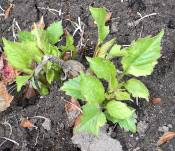
It's very easy to become too enthusiastic when trying out new concepts and ideas. This was such a case. As you can see, the leaves are rather pale, so this could indicate a lack of nutrients (it could also be other things, such as cold - or just because it's new growth).

I think this is because I got clever and failed to place the tubers on multi-purpose compost (I was short of it at the time), as recommended. This would have supplied all the nutrients necessary for healthy strong growth, as it did last year. Soil is most fertile in the upper 'A' horizon, usually within the first 15 to 20 centimetres (6 to 8 inches) where the micro-organisms are most active (due to adequate air).

THE GOOD NEWS SO FAR
Because several shoots are now growing up through this fertile 'A' horizon, the adventitious roots produced on the new stems will have easy access to soil nutrients in this area, something they otherwise would not have done. Thus, using this technique offers a kind of insurance policy against poor conditions.