Showing posts with label pruning. Show all posts
Showing posts with label pruning. Show all posts
19 August 2011
Cutting Back Hydrangeas
Cutting back the fallen hydrangeas last August seems to have worked. They have grown back and flowered well this year (see 'Pruning A Fallen Hydrangea').


5 August 2011
Multi-Plant Breaking Unevenly
 I wasn't going to remove the growing tips at the ends of the 'Annabel' multi-plant shoots. But after removing some of the larger leaves to see what was happening down under, it is clear the axillary buds in the leaf axils haven't broken evenly. In fact, only those marked in pink seem to have developed; the ones marked red have not moved. I hope removal of the apical bud (growing tip) at the end of each stem will now improve matters.
As you can see, I have also used wire to pull some of the branches closer together. This is a good time to do this before the wood becomes too hard and brittle.
Because each of the shoots now has about eight (most have, some haven't) axillary buds (4 nodes x2), there is great potential. Even without further stopping, there should be about sixty to seventy flowering shoots produced. But this won't be till the end of the year, unfortunately. I should have stopped it sooner and potted it up earlier instead of leaving it too long in a small pot. It might have been flowering now. Never mind. Live and learn.
22 July 2011
Increasing Dahlia Flower Stem Length
 The stems on dahlia flower stems are usually quite long enough for domestic display purposes. However, if yours are too short - or if you just want larger blooms - removing the wing buds (marked pink) on either side (red) of the crown bud (lime) will help. Additionally, removal of a couple (or even more) developing lateral buds lower down the stem will help even more; but make sure you leave at least a couple for re-growth.
All the above is usually only necessary for exhibition. And it doesn't suit all cultivars. But it can be a real benefit to some. It's personal choice.
ENSURE WATER IS NOT LIMITED
If water is limited, size of all parts of a plant - especially the flowers - will be reduced. Plants 'cut their coats' accordingly. This is particularly important when the blooms are filling - and I would say even BEFORE the buds become obvious. Plants seem to lay down buds with greater size potential if adequate water is available when the buds are being formed in the floral meristem (floral meristem replaces apical meristem at flowering).
24 June 2011
Minimizing Die-Back When Cutting Back Geranium (pelargonium) Stems
 Cutting back geranium (pelargonium) stems is not so straightforward as it sounds. Firstly, not every node will produce side shoots unless an axillary bud is visible. But geranium stems are often devoid of axillary buds, and any dormant buds are invisible. So we cannot just cut back to any node and expect new shoots to appear where we want them. Quite often, unsightly die-back (pink) left protruding into nowhere is the result of our efforts, try as we might.
This is why I recommend waiting till a strong new shoot is growing before cutting back to it see 'Cutting Back Geranium Stems'.
And even then I leave a good margin of error (red). This can be carefully cut away once our new branches are growing (lime - best if they're growing stronger than this). New cuttings can be taken from the off-cuts.
WHAT IF NO SHOOTS ARE AVAILABLE?
If a stem needs to be shortened and there are not side shoots, cut back about half way and hope for the best. After a few weeks, new shoots might have developed lower down the stem; if not, let them die back, then remove. We can't win them all . . ..
14 May 2011
Severing Coriander Roots Improves Growth
 Since last month, most of the coriander plants with severed roots* have caught up with the control (red). It looks as if severing the roots - thereby inducing earlier lateral root production - can substantially improve growth.
The pot was left without water for a short period, so things have not been ideal. But, provided the plants do not run to seed, it will be interesting to see what happens from now on.
IMPLICATIONS FOR POTTING UP
Many growers pot their plants up into larger pots as soon as the primary root(s) encircle the base of the pot. Instead of this, why not break the root(s) off. The plant could then be left longer in its pot and produce a better root structure which should ultimately lead to a stronger plant.
I have always teased away excess roots encircling the pot of pot-bound plants, then broken it off before re-potting. Until recently, I thought everyone did this.
IMPLICATIONS FOR POTTING DOWN
Who said you 'can't squeeze a quart into a pint pot'? Not me. Not any more. What I mean is that it might be possible to quite severely trim the roots and re-pot a subsequently improved plant into a smaller pot. Of course, exhibition growers have done this for years. I am beginning to see why.
* plants with roots severed half way down the pot, and below
6 May 2011
Inducing A Geranium (Pelargonium) To Branch
Now we have sorted out the watering and the plant has had time to settle down and become familiar with its new surroundings, we can start to shape it how we want. Since each branch has the potential to end in a flower, and since we want lots of flowers (at least, I do), we need to induce it to branch.
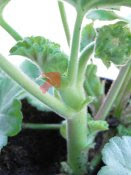 To do this, we remove the young growing tips at the end of each stem, since these contain the apical meristems . This will remove their dominance effect and allow the axillary buds in the leaf axils lower down the stem to develop into side shoots. It's the same process as pinching out a fuchsia.
Were we really keen to produce new green growth, we could remove the flower bud as well. But there's no hurry. The plant already has three stems, and the flowers should give us some pleasure as it matures.
 It is often difficult to know exactly where the meristem is. Although the newest leaf has been removed, this is not, in fact the meristem. This is in the tiny (youngest) mass of tissue attached to it. So, just to make sure I have removed everything, I have removed this newest leaf, as well.
Branching could have been induced later, but it's a good idea to start it as close to the base as possible.
Note: You need to be able to see the axillary buds in the leaf axils - they are not always present.
 To do this, we remove the young growing tips at the end of each stem, since these contain the apical meristems . This will remove their dominance effect and allow the axillary buds in the leaf axils lower down the stem to develop into side shoots. It's the same process as pinching out a fuchsia.
Were we really keen to produce new green growth, we could remove the flower bud as well. But there's no hurry. The plant already has three stems, and the flowers should give us some pleasure as it matures.
 It is often difficult to know exactly where the meristem is. Although the newest leaf has been removed, this is not, in fact the meristem. This is in the tiny (youngest) mass of tissue attached to it. So, just to make sure I have removed everything, I have removed this newest leaf, as well.
Branching could have been induced later, but it's a good idea to start it as close to the base as possible.
Note: You need to be able to see the axillary buds in the leaf axils - they are not always present.
1 April 2011
Geraniums: Removing Unwanted Long Autumn Growth
 The geranium cutting you saw last year has produced lots of new short growth (red) over the winter. This is good, since it will lead to a more compact plant. Pity about the autumn long growth (pink) stuck in the middle. Never mind. Splitting this plant into 3 sections (green) will help remove the unwanted growth.
 This will leave a compact plant with 3 stems (right). Because this plant now has a basic structure, it can be watered and fed to build it up. It can also be re-potted, soon.
 As a bonus, we also have 2 more short-jointed geranium cuttings. I put these into 3 inch square pots of soil to root (square pots cuts down on space). Soil will keep the growth short-jointed whilst we build up the structure of the new plants. I will also keep them on the dry side and will not feed.
10 March 2011
Primary Growth Points (Meristems) Of A Plant
We saw recently that root growth does not occur all over the surface of the roots, but is restricted to the meristems at the tips (hidden within the root cap for protection). Root extension then occurs in the regions just behind. The meristem at the tip of the main root is called an 'apical meristem'.
Similarly, we saw last year that a stem also has an apical meristem. If you remember, we removed this to create bushiness in our plants.
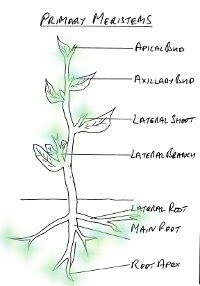 This removal released the dominance effect ('apical dominance'), created by this apical bud, on other meristems in the axillary buds in the leaf axils lower down the stem, allowing these to develop into side shoots.
As with roots, stem growth occurs in the regions just behind these meristems.
The meristems of a typical plant are shown here in green. As growers, we are very much concerned with these meristems, since they control the development of the plant.
Similarly, we saw last year that a stem also has an apical meristem. If you remember, we removed this to create bushiness in our plants.
 This removal released the dominance effect ('apical dominance'), created by this apical bud, on other meristems in the axillary buds in the leaf axils lower down the stem, allowing these to develop into side shoots.
As with roots, stem growth occurs in the regions just behind these meristems.
The meristems of a typical plant are shown here in green. As growers, we are very much concerned with these meristems, since they control the development of the plant.
3 February 2011
Uneven Triphylla Levelled Off
 Although the triphylla fuchsia has resumed growth, as you can see this is very uneven - and the leaves still seem to be the wrong colour.
ALL STEMS CUT BACK LEVEL
 I am hoping that cutting back the longer, more mature stems will help give the smaller ones chance to catch up a bit. The top of the plant is now almost level.
What I am really hoping is that any new shoots developing will be a better colour, then I can take cuttings and start again. But this plant should be all right for the garden.
27 January 2011
Cut Back Fuchsias In Store
 The fuchsias in store in the unheated garage are in a bit of a mess. They haven't been touched since October. I was surprised that they hadn't died back completely; and there are signs of new growth. Trouble is, there's also botrytis on some of the old flowers. I decided to remove this along with all the old dead leaves before the air is thick with botrytis spores.
 I have cut them all back by between two thirds to three quarters and removed all the debris from the compost surface. Then I dusted with sulphur powder to protect the new wounds from botrytis. Sulphur will prevent any spores from germinating.
13 January 2011
Leggy Fuchsias Cut Back
 Although these fuchsia cuttings have survived the winter so far, I want to cut them back to the new buds closest to the compost. This will remove any leggy growth which developed in the warm dull autumn days. Growth is a lot shorter and stronger now. This should produce a better plant. more like a shrub than a tree.
I am a bit worried about botrytis getting hold on the cut ends. If it does, there will be little plant left to save. Will just have to take the risk.
14 December 2010
Should Geranium Shoot Growth Dictate Pruning?
 I hope you can make out the strong new shoots which have grown from the collapsed stems (due to growing too fast) of this geranium. The point here is they have grown in the gap without any encouragement (the stem has not been cut back), almost certainly because the spot has received unrestricted sunlight; nodes further up the stems, which are in the shade because they are behind other stems, have not developed. This looks like phytochrome at work again.
Of course, it could just be coincidence. And, strangely, I have never before noticed such a response. But if new shoots have a preference for non-shade, then it will pay to prune accordingly. In other words, the plant can be pruned into a conical rather than a mushroom shape, thus helping ensure all new buds are free from shade.
Note that when a stem collapses into a horizontal position, the dominant effect of the apical bud is removed and the axillary buds lower down the stem are able to develop (they were previously restricted by auxin produced by the apical bud) into several upwardly-growing new shoots. This effect can often be seen on fallen trees which still have some roots left in tact.
11 November 2010
Cutting Back Geranium Stems
 When geraniums get too straggly, their stems can be cut back to strong-growing side-shoots. You don't have to do this; you can cut to an axillary bud (bud in the axil where the leaf meets the stem). But I find this is not so reliable and can lead to loss of the bud. Be careful not to cut too close to the new shoot (leave at least 5 mm of stem).
I usually cut back one or two long stems per plant at one time (you can cut them all back if you don't mind the complete loss of flowers for a few weeks), choosing shoots which will help shape the plant appropriately. The idea is to get as many new shoots growing from as close to the base as possible, helping to keep the plant compact.
Don't forget to make new plants from the cutting material. If you don't want to pot them up, just stick them in the compost around the plant. They will probably grow into new stems and should soon blend and appear to be part of the main plant. This principle is called 'multi-planting' and is something we shall be dealing with very soon.
Roses Cut Back
 I finally cut back the roses this week, leaving about 15 cms (6 inches) of stem. Not so much as last year (down to 5 cms); but afraid of another hard winter.
They have flowered very well this year, but seem to have given a very heavy first flush and no second; then a third, and were just budding up for a fourth. This is probably because I have given more feed than normal at the start of the season.
Blackspot does not seem to have been much of a problem this year, probably because they were cut back so much. Cleared away all old rose leaves. Will probably spray the stumps (blackspot over-winters on the stems) and soil surface (it over-winters here as well) in mid-winter to kill any over-wintering spores.
23 September 2010
Fuchsia New Growth After Cutting Back
 This fuchsia was cut back a few weeks ago, down from about 30 cm (12 inches) to a height of 5 cm (2 inches). Before you sharpen the secateurs, can I say that I don't recommend you treat your plants this way, not yet anyhow. I did it because I suspected Red Spider Mite on the lower leaves (this is virtually impossible to eradicate - hence the drastic treatment to remove all the leaves and most stems).
It is in a 3.5 inch (9 cm) pot and rooted in soggy slimy compost. Yet, despite all these negatives, it looks as if it is starting to thrive. Why?
I don't know. But it must have a lot to do with being kept outside for the past few weeks. In fact, it almost certainly is this, because I have a similar plant which is doing even better (although that one is in a pot containing garden soil).
When we remove plants from their natural environment, we seem to be courting trouble. So this result is not exactly unexpected. But I find it amazing that fuchsias indoors (and even in other pots) seem very intolerant to over-watering.
The difference is probably the temperatures. Fuchsias seem to be much more water-tolerant at lower temperatures (which is logical when you think about the seasons - most springs and autumns are wetter than summer).
However, it is not all rosy. If you look at the branch in the top left corner, you might see our new friend 'Botrytis' making an appearance. I have dusted it with sulphur for now, trying to avoid the new growth.
16 September 2010
More Cutbacks
 This was the lovely Gartenmeister Bonstedt triphylla fuchsia a few days ago (as you can see, it's grown somewhat since we got it in May.

And this is how it looks now.
Do you think I might have overdone it? We shall soon see - it's kill or cure, once more.
The idea is to get more new shoots to spring up from the base.
What I have actually done is trimmed off the outside roots and the root base to sink the plant nearly 5 cm (2 inches) deeper into its pot, then covered the surface and sides with new compost.
P.S. As insurance, I've taken lots of cuttings.
12 August 2010
Pruning a Fallen Hydrangea
 Think the second feed did it (we'll ignore the torrential downpours) - reduced a gorgeous hydrangea to this fallen state. But it was good whilst it lasted. Now we need to thin it out in such a way as to avoid destroying next year's blooms.
The standard way to prune shrubs which flower in the second part of the year is to cut them back to a healthy bud in late winter/early spring, as soon as the danger of severe frost has passed and the first glimmers of growth are showing.
Problem is, if hydrangeas are cut back too far, they don't flower that year. So, apart from taking about a quarter of the stems back to the floor this spring, I have been reluctant to cut the rest too much. Gradually, over the years (it's now 10 years old), it has got taller and taller. Now it's too tall. I have to do something, if only thin it out and get it back on its feet (the blooms are holding too much water, too much weight).
 I read that if mopheads can be cut back early enough - whilst they are flowering but before the new flower buds are set - they will still flower the next year. The recommended time is July to early August. But the blooms had hardly opened in July, and some are still growing (most are about 20 cm (8 inches) diameter), that's the problem.
So I might be too late; there are already buds developing on the stems (purple on old wood and green on new). Can't tell if these are flower buds, or not.
Anyway, I have now thinned it out by cutting back about half a metre (18 inches) to a healthy bud.
29 April 2010
Pruning Forsythia
Pruning has always been something that never seems to work for me as it should.
No matter how I try, I always seem to lose out on flowers, in one way or another.
The theory is simple:
Shrubs which flower early in the year (usually before July) produce new wood during that year and this bears flowers the following year. Because it is produced early in the year, it has time to harden off before winter. However, we need to be quick and prune as soon as the flowers have faded.
Shrubs which flower in the second half of the year do not have time to harden their new wood before winter, so to avoid damage they are best pruned in late winter or early spring of the following year. They will then bear flowers on this new wood.
It all sounds so simple. Not for me. I have tried all ways. I just never seem to get it right; if I cut back any earlier there would be no flowers. And not only this, professional gardeners treat pruning as some sort of arcane art - some sort of secret they mustn't divulge. Arcane art or not, if you are thinking about doing some pruning, can I give you some advice?
Think again. Do you really really have to do it?
A good principle in growing is the old adage: IF IT AIN'T BROKE, DON'T FIX IT.
So don't prune before you really have to. And bear in mind that many shrubs do not need pruning.
However, if you really must, then understand why you are doing it. Is it:
By all means feel free to follow your own judgement. Go to the library and take out a good textbook on pruning. If you know the name of your shrub, detailed instructions can be found. Follow them carefully.
RESTORING FLOWERING VIGOUR
Some shrubs (e.g. hydrangeas and roses) need young vibrant stems to produce their best flowers. As the stems lengthen, the flowers gradually become smaller and smaller. Giving these plants a really hard pruning re-invigorates them. And the harder we prune them, the more they like it. They will supply you with exhibition quality blooms (this applies to most plants, in my experience).
Contrary to consensus, you don't really need to know anything about pruning to deal with this situation.
All you need do is cut back one or two of the oldest, most gnarled stems down to about 15cm (6 inches) above the ground each April, whether they are flowering or not. You will probably lose the flowers on these stems (that's why only one or two), but you will hardly notice, especially if they are outside stems. Don't worry about damaging the plant. You are likely to do more good than harm (because you are inducing production of new wood).
SHAPING AND REPAIRING
Thinning
All plants need air circulating freely amongst their leaf canopies. To facilitate this, the best shape is long, almost parallel, vertical stems, each with just a few side branches. Cut off all branches which cross each other, especially the thinner ones (and the dead ones) which look untidy - cut these right back to the stem, being careful not to cut or damage the stem. Just leave a few branches. It might look horrific at first, but the new thinner look will soon grow on you.
Shaping
Sometimes branches become damaged or misplaced by the wind. Cut these back as far as necessary to restore the shape.
If the plant is becoming too large, consider whether you can just cut back a few stems this year, followed by more next year, and so on. If you want to reduce the shrub's size, do not cut these stems right back; ironically, this usually gives them so much vigour that they might even be taller by next year. No. Cut them to just below the required height.
If you want to use clippers or a hedge trimmer to trim them all over, bear in mind that you will probably lose a year's flowers. But you will not do any permanent damage.

 As you can see, I usually get too carried away when I eventually get around to pruning. But this forsythia will soon fill in with new wood. And there should be enough old shoots left to get at least some flowers next year.
No matter how I try, I always seem to lose out on flowers, in one way or another.
The theory is simple:
Shrubs which flower early in the year (usually before July) produce new wood during that year and this bears flowers the following year. Because it is produced early in the year, it has time to harden off before winter. However, we need to be quick and prune as soon as the flowers have faded.
Shrubs which flower in the second half of the year do not have time to harden their new wood before winter, so to avoid damage they are best pruned in late winter or early spring of the following year. They will then bear flowers on this new wood.
It all sounds so simple. Not for me. I have tried all ways. I just never seem to get it right; if I cut back any earlier there would be no flowers. And not only this, professional gardeners treat pruning as some sort of arcane art - some sort of secret they mustn't divulge. Arcane art or not, if you are thinking about doing some pruning, can I give you some advice?
Think again. Do you really really have to do it?
A good principle in growing is the old adage: IF IT AIN'T BROKE, DON'T FIX IT.
So don't prune before you really have to. And bear in mind that many shrubs do not need pruning.
However, if you really must, then understand why you are doing it. Is it:
- To restore flowering vigour?
- To shape or repair the shrub?
By all means feel free to follow your own judgement. Go to the library and take out a good textbook on pruning. If you know the name of your shrub, detailed instructions can be found. Follow them carefully.
RESTORING FLOWERING VIGOUR
Some shrubs (e.g. hydrangeas and roses) need young vibrant stems to produce their best flowers. As the stems lengthen, the flowers gradually become smaller and smaller. Giving these plants a really hard pruning re-invigorates them. And the harder we prune them, the more they like it. They will supply you with exhibition quality blooms (this applies to most plants, in my experience).
Contrary to consensus, you don't really need to know anything about pruning to deal with this situation.
All you need do is cut back one or two of the oldest, most gnarled stems down to about 15cm (6 inches) above the ground each April, whether they are flowering or not. You will probably lose the flowers on these stems (that's why only one or two), but you will hardly notice, especially if they are outside stems. Don't worry about damaging the plant. You are likely to do more good than harm (because you are inducing production of new wood).
SHAPING AND REPAIRING
Thinning
All plants need air circulating freely amongst their leaf canopies. To facilitate this, the best shape is long, almost parallel, vertical stems, each with just a few side branches. Cut off all branches which cross each other, especially the thinner ones (and the dead ones) which look untidy - cut these right back to the stem, being careful not to cut or damage the stem. Just leave a few branches. It might look horrific at first, but the new thinner look will soon grow on you.
Shaping
Sometimes branches become damaged or misplaced by the wind. Cut these back as far as necessary to restore the shape.
If the plant is becoming too large, consider whether you can just cut back a few stems this year, followed by more next year, and so on. If you want to reduce the shrub's size, do not cut these stems right back; ironically, this usually gives them so much vigour that they might even be taller by next year. No. Cut them to just below the required height.
If you want to use clippers or a hedge trimmer to trim them all over, bear in mind that you will probably lose a year's flowers. But you will not do any permanent damage.

 As you can see, I usually get too carried away when I eventually get around to pruning. But this forsythia will soon fill in with new wood. And there should be enough old shoots left to get at least some flowers next year.
2 April 2010
Roses now after hard pruning in autumn
 Cutting the roses right back to about 15 cm (6 inches) high in October has caused problems. Instead of growth stopping then, as it normally does, the mild weather allowed new buds to develop. These (ringed in red) suffered in the harsh frosts, stimulating even more new buds. Now there are almost too many.
Will have to reduce these if I want big roses, but not sure yet which ones to remove. It is not hard to do: just rub off with thumb. But I never like killing buds - or killing any form of life, for that matter. However, it looks as if it will have to be done. Will have to remove some more dead wood, as well.
I normally cut roses down to about 30 cm (one foot) in autumn, just to stop them rocking in the winds, then cut them again to about 6 inches in early March. Last year was first year I had ever cut them back so much at this time. The idea was to get them a bit earlier.
It is just something else that has gone wrong with the garden. However, all is not bad. At least there are strong new shoots developed. Its the little puny ones I need to get rid of.
P.S. Cutting back old tired roses really hard (as I have done) rejuvinates them. They suddenly start throwing strong new shoots from around base. These are the best forms of shoots and they produce big luscious blooms.
Subscribe to:
Posts (Atom)