I have had a real problem with botrytis on fuchsias this past year. Much has been learned. That's how it is with growing - trial and error - almost despair, at times. However, I noticed last winter that certain pots remained completely free of this disease. Why? Because I didn't need to water them. The compost surface dried out, leaving sufficient water down below to last a few months.
WETNESS OF COMPOST
The pots were given the maximum amount of water before October (when botrytis really became a problem due to colder temperatures), but the compost surface had enough time to dry out. The plant roots, as they grew, could then access water deeper in the compost. This way, these pots did not need to be watered again till growth recommenced the following year. And even if they did, they could be watered from the bottom by standing in a saucer of water for a few minutes.
This really worked last year. It was those pots that I didn't water in time - and so were left with a wet surface - which suffered.
COMPOST TURNS SOUR?
Many will tell you that wet compost turns sour. Yes it does. But, in my opinion, this only happens when it is too wet and consequently deprived of air. Adding some perlite and/or grit will help control this.
HOW MUCH WATER?
The limiting factor as to how much water can be given is the plant(s) itself. Fuchsia roots cannot tolerate over-wet conditions for long periods. So you need to give as much as you can without drowning the plant. Only experience can help here.
DON'T WATER TOO SOON
It is surprising how dry a compost can become before it affects fuchsias. In fact, they positively thrive on a drier one. But not TOO dry - otherwise the roots will shrink and cause permanent damage. It's a very narrow margin, but one that is worth discovering if you want to grow fuchsias well.
Showing posts with label storage. Show all posts
Showing posts with label storage. Show all posts
19 August 2011


12 August 2011
Multi-Plants Look Good Right From The Off
 Now is a good time to take cuttings of favourite plants, either as insurance against a bad winter, or perhaps just to increase stock. Take about six or seven shoot tip cuttings, a 3.5 inch potful of light soil or rooting compost (preferably the one we use on fuchsias), and insert five or six cuttings close to the edge, with one or two in the middle. No need to cover. These should root fairly quickly at this time of year.
 Making multi-plants this way was very effective last year. This is a multi-plant, made of pinks last August, in early October. I made one from French lavender, as well. Both have flowered very well this year as part of mixed containers.
Multi-plants in small pots are easy to store over winter. And they look good right from the off because the plants don't need to build up a framework of stems before they can flower well. The structure is already there. Each stem will very quickly bear a flower. And, once mature, these plants can look fantastic!
22 July 2011
Dahlia In A Cup
 I know it's not very clear. But this is a dahlia cutting in a 500ml (pint) plastic cup filled with soil. Although the cutting was pushed down the side of the cup (its stem was visible until the green algae formed), there is still no visible sign of any root development 32 days after planting. I know I didn't use rooting powder. But I'm sure it HAS rooted, because it's held firmly and is growing. Hope roots appear soon.
POT TUBERS
I thought it would be good to see how the roots and tubers develop (should they ever appear), just as we did with the potato. Incidentally, it's worth growing a few cuttings like this and keeping them in pots (3.5 inch). They over-winter very well, once dried, and take up little space.
10 June 2011
Advantages Of Storing Begonia Tubers As Root Balls
 Many begonia growers brush their tubers off before storage. I have never had much luck with this method. I always store mine as a root ball complete with soil or compost, and find it has advantages.
ADVANTAGES FOR STORING
Although I stop watering my begonias in pots around the start of October, I still find they do not really dry out. Consequently, it is for me almost impossible to clean them without breaking the tubers or damaging them in some way. So I just place them in an airy spot to dry them as much as possible before storage, then don't cover until the really severe weather comes. They seem to store well this way with little or no disease problems. We covered lifting begonias last year.
ADVANTAGES FOR PLANTING
Once it becomes clear in early spring that tubers are showing signs of growth, root balls can be watered lightly and placed in a light frost-free place. This helps them along and avoids the need to pot up the larger tubers which are almost impossible to fit into almost any pot.
 BEWARE OF VINE WEEVIL GRUBS
The tuber above has been treated as described and can now be planted as it is. However, it will need some treatment for vine weevil grubs which will almost certainly have overwintered with the tubers and will be hiding in the roots somewhere. I use 'Provado Vine Weevil Killer', a stronger dose of thiacloprid.
14 May 2011
Natural Rain Water Is Best
The recent rainfall has done wonders for the soil. And now with overcast conditions, moist soil and constant showers, it's almost perfect (apart from the wind) for planting. After deliberating long and hard, I decided to lift the daffodils early and get some more dahlias in, just in case the dry weather comes back.
It's always best to work with nature. But, apart from this, I don't like watering, at the best of times - I always feel it's cheating, somehow. And plants don't grow as well on tap water as they do on natural rain water.
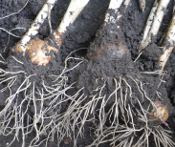 Laid bulbs, leaves in tact, out on floor in a cool, light spot, out of direct sunlight. Will have to watch they don't dry out. Normally, flowering has been over for 3 or 4 weeks by this time. But this year, because I used a mixed bag of bulbs, some flowers have only just finished. Growing is always a compromise.
It's always best to work with nature. But, apart from this, I don't like watering, at the best of times - I always feel it's cheating, somehow. And plants don't grow as well on tap water as they do on natural rain water.
 Laid bulbs, leaves in tact, out on floor in a cool, light spot, out of direct sunlight. Will have to watch they don't dry out. Normally, flowering has been over for 3 or 4 weeks by this time. But this year, because I used a mixed bag of bulbs, some flowers have only just finished. Growing is always a compromise.
6 May 2011
Dahlias In Beds Have Survived
 I never expected to be able to show you this - a new shoot springing from a dahlia overwintered in a flower bed - not after the winter we have just had. I did not cover the plants. They were left untouched in the beds about 10 to 15 cms (4 to 5 inches) deep. Amazing. Dahlias definitely do seem much more frost tolerant than we think - unless I just have some frost-tolerant varieties.
14 April 2011
Watering A Cyclamen For Dormancy
 As days get longer, especially as it hots up, pot cyclamens decide it's time for a rest; in this case, a well-earned one. Despite starting flowering a month late it then continued as per normal.
JUST ONE LAST DRINK
What I do now is give it a final light watering to see it through the 'shutting down' into dormancy. Although the plant seems to be dying back, its leaves will be working overtime, making food for the corm so it can keep ticking over. Gradually, the leaves will die back as everything dries. I leave the leaves on.
You can lay it on its side, as recommended. However, provided the crown of the tuber is dry enough, you don't need to. That's all there is to it 'till the first signs of new life appear around the middle of June. Could do with a good rest, myself.
20 January 2011
Shocked By New Buds on Begonias In Store
 After being caught unprepared by the plummeting temperatures in December, I thought it a good idea to try to propagate some new begonias in case any have been lost. I was shocked to find new buds on one begonia tuber in store.
 Although fresh, these buds look as if they have been growing for a week or two. But why have they appeared? The tuber has been in an unheated garage, subjected to freezing conditions whilst only covered loosely by a few sheets of newspaper. It doesn't make sense.
The only reason I can give is that the tuber might think it's spring. But although temperatures have been mild this past week or so (about 10 deg C (50 deg F)), this is hardly high enough, or long enough, to sustain so much development. Another mystery.
Will run propagator at about 15 deg C (59 deg F) for a while and see what happens. Have packed tubers with garden soil. Need to watch out for any slugs hatching out.
6 January 2011
Why Has Old Begonia Stem Not Fallen Off?
 It's not the Botrytis creeping all over this old broken begonia stem that's the problem. This has already been treated with kitchen bleach (carefully so as not to get any on the compost), a treatment which worked a treat on the Triphylla Fuchsia back in October. No. It's the fact that it's still firmly attached to the tuber; it has not fallen off as it should have done.
Normally these old stumps can be found lying on the compost some time in December, leaving behind a nicely-healed wound (I'm not sure this is formed in the same way as an abscission layer in a leaf petiole (stem)). Had this happened, fungal infection would not be a problem, since the scar (scab) would prevent entry of spores (a fungus's equivalent of seeds). However, tearing away the stump could open the wound which, in the moist warm conditions needed for germination, could create problems.
It's as if the tuber has been forced prematurely into dormancy before it could finish its work, probably by the sudden influence of plunging temperatures. Even worse: the tuber could have been frozen - it might be dead.
I don't know what will happen now things have warmed up a little - I was hoping to start propagating some begonias later this month. If there's no improvement within a couple of weeks, I might gently break it off and treat the wound with yellow sulphur powder to kill any unwanted disease spores. But I don't want to do this. There is always a chance things could go wrong.
29 December 2010
Surprise Beneath the Fleece
 I don't have to tell you it has been cold. And when I say 'cold', I do mean 'COLD' (us Brits are a bit 'nesh', to say the least - except for our Scottish contingent who can chew nails and spit rust). So I could hardly believe my eyes to find this fuchsia looking up at me the other day. It has been under a double fleece plus three sheets of newspaper for at least two weeks. Incredible. I thought it would have been long gone. However, not only has it survived, it doesn't even appear to want to shut down.
As you can see, there seems to be only the slightest hint of frost damage. Temperatures have not been that low - not with a 60 watt tubular electric heater in the porch - but they have been well below zero on several occasions, otherwise consistently just a couple of degrees above freezing.
But it's not just the temperature: it's the light, or lack of it (because of the newspaper). I thought there would have been signs of chlorosis (yellowing) before now.
PERHAPS THE CLUE IS IN THE FLOWERS
I'm not sure if you can see them, but apart from the healthy green colour, what really struck me were the fresh flower buds. Flowers in December? Amazing. Well, perhaps not:
Flower buds are laid down in the meristems long before there is any hint of their existence. And with temperatures being so low for so long, there has been little development in the growth process. Growth slows down dramatically as temperatures fall. And if I were to say that the cuttings taken in October have taken 8 to 10 weeks to develop roots (versus 10 days in May), it becomes clear that these flowers might have been developing for at least the same amount of time.
Nevertheless, this plant's persistence makes me think there is some sort of 'determined effort' to flower at all costs - to finish the job it has started. I know this is ridiculous. But who knows? Stranger things have happened at sea . . ..
18 November 2010
Checking the Drainage
As you know, I have now lifted and stored some of the dahlias. But I usually leave some in the ground all winter. They seem to survive very well like this, especially if planted deep (at least 10 cm) and get some sun during the day. The sun thaws out any frost and prevents it penetrating deep into the soil during any weeks of continuous 24 hour bouts of freezing temperatures, usually in late December-early February when days are shortest. If storage is a problem, you can do this as well, with one proviso: the soil must not become water-logged.
What causes water logging? - Poor drainage.
How do you know if you have it? Dig a narrow hole about a spade deep and watch it. If it doesn't drain within about 8 to 10 hours after a bout of heavy rain, then drainage is a problem. If it doesn't rain, tip in a bucket of water. (Incidentally, if it drains too quickly, this indicates another problem - too-light soil (remedy by adding clay or compost)).
FACTORS CAUSING POOR DRAINAGE
High Water Table
As winter approaches, the water table gradually rises and can even reach the surface causing bogginess, even permanent puddles of wataer. This problem usually occurs with low-lying land; it does not affect most gardens since it is low enough beneath the surface. However, if you have this problem, you should think about a drainage system. Unless you do this, your plants will never do well (unless, of course, they are bog plants).
Heavy Soil
Heavy soils, such as clay, do not drain fast enough in times of continual rain. Dahlia roots (and also those of many other plants, especially bulbs and corms) do not like this and will quickly rot. Planting in sand will help to keep the cold wet earth away; it will also improve drainage by keeping the soil open. Adding compost, sand, or horticultural grit will help to improve the drainage.
Hard-Pan
If you live in a new property (or an older one), the garden might have been created by dumping topsoil onto what was effectively a building site compacted by heavy traffic. As the surface water seeps down, it is prevented from getting away by this layer and thus creates a false water table.
Hard-Pan can be cured by penetrating the pan, the more places the better. Although double-digging is best, just loosening the soil in spots close to each other will have a large effect. If you do double-dig, try to avoid mixing the subsoil (usually the lighter soil) with the topsoil (the darker soil), since it is invariably infertile. After removing the first spadeful, try to loosen the lower layer without lifting it out; this will allow the water to get through.
Dahlia Tubers Ready for Storing
The soil on the inverted dahlia tubers in the garage has now dried sufficiently to turn them right-way-up. The tubers are not soft but are not nearly as brittle and delicate as they were - drying has made them leathery, ideal for resisting light frosts. I will not cover them until harsh frosts are forecast. This will help keep the necks (the part where the stem meets the tuber) dry and rot-free.
TUBERS ARE NOW DORMANT
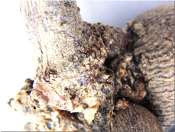 This is the only washed tuber on its way to the fridge (it hasn't got there yet). It's not my day for photographs, but the small reddish dots on the neck (roughly in the centre of picture) are the dormant axillary buds from which next year's new growth will emerge. The fact they are not developing shows that the tuber is dormant, probably because of low temperatures and loss of foliage.
TUBERS ARE NOW DORMANT
 This is the only washed tuber on its way to the fridge (it hasn't got there yet). It's not my day for photographs, but the small reddish dots on the neck (roughly in the centre of picture) are the dormant axillary buds from which next year's new growth will emerge. The fact they are not developing shows that the tuber is dormant, probably because of low temperatures and loss of foliage.
28 October 2010
Fuchsias Caught by Frost?
Sunday night's frost was hard for October - looks as if I might have been caught out with the outdoor fuchsias.
I had been awaiting a slight frost to kill the foliage, along with any insect pests living on them, before storing. Too much frost can kill the stems, as well. Still, 'no use crying . . .', so to speak. 'What's done is done', and all that. I put them into the garage before it started raining.
Once the dead leaves have decided to drop, I will completely remove them all, spray the plants with a pesticide, then the plants and compost surface with a fungicide, and await the worst. It should be obvious by mid February whether they have survived or not.
At least the compost is not too wet. Even so, I shall have to watch out for signs of botrytis appearing on any dead material lying on the compost.
NO LIGHT NEEDED IN STORAGE
Fuchsias can be stored in any frost-free place such as a garage or attic. They can even be buried in the ground. Light is not necessary until new growth commences.
21 October 2010
Make a Concrete Floor Work for You
Most people I know protect their plants against the cold of a winter concrete floor by packing their plants on paper or timber.
I don't. I'm greatful to have one in my garage. Because of concrete's heat capacity, it acts like a huge storage heater on cold nights - very useful when air temperature drops below freezing point. Newspaper or similar over the plants prevents heat loss by radiation and holds in the air warmed by the floor. It also evens out the diurnal (day and night) temperature range.
Of course this only works if the concrete is above 0 deg C. But it would have to be an awfully cold (one which we have hardly ever - maybe even NEVER - had) for this to be the case, unless the plants are placed too close to an outside wall. This is because of the heat rising from the ground beneath the concrete.
If, however, plants are packed on newspaper or timber, this heating effect cannot work as well, and the plants are more exposed to the cold air temperatures.
Incidentally, a deep concrete floor has the same effect in a greenhouse, keeping it warmer in winter and cooler in summer.
Containers Indoors
I took the opportunity to take containers of geraniums (pelargoniums) indoors before the weather broke whilst they were dry. There is still some water in the compost, enough to see them through the winter. I sprayed them with 'Systhane Fungus Fighter' (1.53 g/l myclbutanil) beforehand because of problems with leaf spot and botrytis.
The fuchsias and late begonias are still flowering well, despite the slight frost. They are close to walls in sheltered positions.
The fuchsias and late begonias are still flowering well, despite the slight frost. They are close to walls in sheltered positions.
Storing Dahlia Tubers
The idea here is to keep the tubers cool enough and dry enough to prevent premature re-growth whilst taking care they do not get frosted. In practice, this means storing them between 4 - 10 deg C (40 - 50 deg F). This is not a problem if lifted at this time of year and stored in a frost-free outer building.
If you have space, I find it best to store them as they are, with the fleshy roots partly covered in soil. However, if space is limited, the roots can be split up and stored as individual tubers.
STORING UN-SEPARATED TUBERS
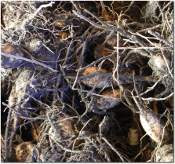 I lift my dahlias after the first frost (see 'Lifting Dahlia Tubers'), then leave them upside down to allow the moisture to drain out of the cut stems and the soil to partly dry out around the fleshy roots.
As the roots dry out they become softer and more rubbery. This is good, since it allows them to tolerate light frosts.
I then invert the roots back upright and place them into storage position. But I DO NOT COVER THEM.
I find it is the neck of the tubers (the part where the swollen root joint the stem) which is most vulnerable, especially to insect larvae attack and to over-wetness. Leaving them open to dry air allows the necks and stems to dry out. "Derris" dust helps control insects.
I only cover them in mid December to protect them against the most severe of frosts, though this is probably not necessary. I am always amazed at how well they survive outside in 5 cm (20 inch) containers exposed to the full winter weather, even though the roots are very close to the surface. However, storage in smaller containers causes problems; they will not tolerate completely frozen compost.
STORING INDIVIDUAL TUBERS
 After careful removal of the soil, it is usually possible to prise a single tuber away from the rest, complete with a short piece of attached stem. These can be washed if required, and any wounds should definitely be treated with yellow sulphur powder to prevent fungal infection.
Place in the refrigerator, taking care that they do not get too near to the cooler. Many growers say they store them in polythene bags, but I don't like the idea of this because they tend to sweat. And the last thing we want is a wet tuber. However, we don't want one which is too dry, either. I think I would be inclined to wrap them in kitchen towel, then place them in a polythene bag - full of holes - if they were drying out too much.
If they are dusted in sulphur, they would better tolerate slight moisture. And they might store best like this.
Examine them often for signs of disease, especially over the first few weeks. Remove problem tubers.
If you have space, I find it best to store them as they are, with the fleshy roots partly covered in soil. However, if space is limited, the roots can be split up and stored as individual tubers.
STORING UN-SEPARATED TUBERS
 I lift my dahlias after the first frost (see 'Lifting Dahlia Tubers'), then leave them upside down to allow the moisture to drain out of the cut stems and the soil to partly dry out around the fleshy roots.
As the roots dry out they become softer and more rubbery. This is good, since it allows them to tolerate light frosts.
I then invert the roots back upright and place them into storage position. But I DO NOT COVER THEM.
I find it is the neck of the tubers (the part where the swollen root joint the stem) which is most vulnerable, especially to insect larvae attack and to over-wetness. Leaving them open to dry air allows the necks and stems to dry out. "Derris" dust helps control insects.
I only cover them in mid December to protect them against the most severe of frosts, though this is probably not necessary. I am always amazed at how well they survive outside in 5 cm (20 inch) containers exposed to the full winter weather, even though the roots are very close to the surface. However, storage in smaller containers causes problems; they will not tolerate completely frozen compost.
STORING INDIVIDUAL TUBERS
 After careful removal of the soil, it is usually possible to prise a single tuber away from the rest, complete with a short piece of attached stem. These can be washed if required, and any wounds should definitely be treated with yellow sulphur powder to prevent fungal infection.
Place in the refrigerator, taking care that they do not get too near to the cooler. Many growers say they store them in polythene bags, but I don't like the idea of this because they tend to sweat. And the last thing we want is a wet tuber. However, we don't want one which is too dry, either. I think I would be inclined to wrap them in kitchen towel, then place them in a polythene bag - full of holes - if they were drying out too much.
If they are dusted in sulphur, they would better tolerate slight moisture. And they might store best like this.
Examine them often for signs of disease, especially over the first few weeks. Remove problem tubers.
Insect Pests on Over-Wintering Dahlia Tubers
 Slugs, earwigs (pictured) and wireworms are all serious pests which can over-winter with stored dahlia tubers. Of these, I have found wireworms to cause the worst damage, since they attack the necks and render the tubers useless; the other two attack the young plants during the next growing season.
Although I have never stored tubers individually, complete removal of soil and a thorough washing is obviously ideal for removing pests, along with their eggs. If the pest problem is severe, this might justify the increased risk of loss of tubers through disease (especially if tubers were dusted with sulphur powder).
So far, this has not proved necessary. I have found a dusting with "Derris" dust ('0.2% w/w rotenone') effective against wireworms. The others are removed with the soil just prior to planting. Though, to be honest, I haven't really had a problem with earwigs before. It might be worth spraying tubers with 'Provado Vine Weevil Killer' (9g/l 'thiacloprid') at some stage.
Lifting Dahlia Tubers
 Decided to lift all dahlias and put them into store over winter. Recent rains has left soil in ideal condition for lifting - not too wet, yet not too dry.
It is important to use a fork or spade deep enough to reach the bottom of the tubers, if damage it to be avoided. I use a fork.
- Insert fork to full depth about 25 - 30 cm (10 - 12 inches) away from stems and pull handle backwards with one hand whilst pulling foliage with other hand. Take care not to pull foliage too hard, to avoid tearing.
- Cut down stems to within 5 cm (2 inches) of tubers, then label.
- Dust neck of tuber with "Derris" dust. This is where wireworms seem to attack in storage.
- Invert tuber to drain moisture out of stems.
- Leave inverted for a few weeks to cure (tubers go soft and rubbery, and are able to withstand more frost).
14 October 2010
A Good Dry Spell
The recent dry and frost-proof weather has given everything a chance to dry out, especially the pots and containers.
Although I have lifted a few early-flowering plants for storage, the majority of the garden is still in nearly full-bloom. I like to see a light frost kill the foliage before cutting back and storing, since this tends to kill any bugs, as well.
I take pots of geraniums and other delicates indoors just before the frost arrives. This gives them the best opportunity to dry out.
Anything planted deep in the soil (e.g. dahlias) do not need lifting. They might keep best in the ground, provided it does not get too wet for too long. I am leaving mine in for now, but will be lifting some soon.
Do not put wet plants into storage.
Storing Border Geraniums Over Winter
STORAGE IN AN OUT-BUILDING
For over-wintering in an outside building (garage or shed), I store them with some soil around the roots. They can be dug up carefully and placed straight into pots, then left to dry out naturally in airy conditions. Do not to use too small a pot; they tend to do best when it is at least 5 inches (12.5 cm). Do not water till spring.
Do not cover until it is really necessary, usually in late December to mid February. I only cover when hard frost is forecast, then remove covering between frosts. Keeping them dry is the plan.
STORAGE INDOORS
The above method can also be used indoors. However, to avoid discovering any little strangers (creepy-crawlies) on the window sill, it might be wise to sterilize the soil. This is especially wise this year, since fungal leaf spot has been a problem. Sterilization will prevent it over-wintering in the soil.
As described elsewhere, a microwave oven is useful for sterilization.
Subscribe to:
Posts (Atom)