The increasingly heavy overnight autumn dews in the UK create ideal conditions for moss establishment (or re-establishment!). Spores which have lain dormant during the summer months become active and can soon overpower even the healthiest of lawns. So we need to beware. Now is an ideal time to get down close to the turf and examine it carefully for strands of moss.
If moss has previously been a problem, I recommend an application of ferrous sulphate (19% soluble sulphate of iron) at 1 ounce per gallon of water per 10 square yards (35g per 4.5 litres water per 9 square metres). With the right rose, it doesn't take long to apply with a watering can (you might need to experiment with different ones to get the delivery rate right). I would give this treatment whether you can see any moss or not; any present will turn black almost instantly. You might be amazed at how much there is.
REPEAT TREATMENT IF NECESSARY
I dealt with moss treatment in great detail last year (see last autumn's lawn posts). But I didn't make it clear that we need to keep an eye out for moss re-establishing after a month or two. If it does, then repeat the treatment. You can do this as many times as necessary.
If you keep 'nipping it in the bud', you will keep it in check without disfiguring the lawn. i.e. the dead moss will quickly grow over, so there should be no need to rake.
RAKE OUT IF NECESSARY
If moss is really bad, then now is the time to kill it off and rake it out. There is still time for the turf to at least partly recover before winter. This way it will not look as unsightly as it would if left till later, or - even worse - next year.
Showing posts with label lawn. Show all posts
Showing posts with label lawn. Show all posts
19 August 2011


22 July 2011
All That Rain Wasted On Lawn
 It hardly seems credible. Three days and three nights. Almost incessant rain. Nearly 10cm (4 inches) in a week. Enough to get down at least a couple of feet. Maybe even deeper. Even in the driest soil. My lawn never ceases to amaze - parts are still almost dry.
 Of course, I should have allowed for the thatch. I should have known the rain would not penetrate, not without pricking a way through. After all, I've talked about it often enough. And anyway, it was too hard to use the spiking tool. Even now it's hard to push a fork in.
I could have gone out in the rain. I could have spiked it once the turf had begun to soften. But I would have got very wet. And I suppose I figured it would stop raining a while. It didn't. And now it's too late. The rain has gone. At least that which was most valuable. All that rain wasted . . . Blast.
8 July 2011
Dead Spots On Lawn
 Spots of dead grass, about 2 inches (5cm) diameter, on a summer lawn are usually caused by 'Dollar Spot Disease'. Gradually, these coalesce into larger dead patches which are very disfiguring.
This is a fungal disease in which the leaves of the finer grasses (especially those of creeping red fescue and cumberland turf) die back in hot muggy weather. Normally occurring in August in the UK, last weekend's weather will have caused the problem.
CONDITION NOT TERMINAL
The condition is more cosmetic than terminal. Rake out the dead grass. Once the weather cools down, apply a feed if necessary. Things should then be fine.
Note that small dead spots can also be caused by other things such as petrol drips.
1 July 2011
Slow-Release Lawn Feeds Create Problems
 Although slow-release lawn feeds have a lot going for them, they also create problems. I'm not referring to the fact that the grower loses nearly all control over the rate of food release to the turf (because they work best in wet, warm conditions and hardly work at all in cold, dry ones). No. There's another problem: They preclude work on the turf whilst they are active. And because some of them last over four months, this means for the whole summer.
Normally, this would not be a problem. But it is on my lawn. I can't rake out the old dead grass, which would help get air and water in to rejuvenate the turf, because if I do this I will also remove the remaining feed. Not ideal.
3 June 2011
Dealing With Moss In A Summer Lawn
Apply Summer Feed First (should control it); Mosskill Later, If Necessary
Treating a lawn for moss is rather like a doctor treating a sick patient. The first thing to do is control the suffering - usually with drugs or other chemicals - then work on changing, if possible, the conditions which caused it. And just like any sickness or ailment, treatment can be applied AT ANY TIME. It's just that some times are more cosmetically amenable than others. Now, the summer, is such a time.
Before I go any further, can I apologise to those of you who tried my autumn moss treatments described last year (click 'moss' link at side), but have found moss re-growing in their turf this year. It's my fault, not yours. I should have made things clearer. In case you are sick of hearing about moss and don't want to read further, here is a quick prognosis:
MOSS NEEDS REPEATED TREATMENTS
Consequently, moss is difficult if not impossible to eradicate AT ONE ATTEMPT; it has to be ground down over a period of time with REPEATED TREATMENTS. But hold on. I'm not talking about all the hard work you did to aerate and loosen your turf. I'm talking about another dose of ferrous sulphate in water.
NIP IT IN THE BUD
I'm sorry I didn't make clear that you need to watch the turf closely for signs of regeneration, then nip it in the bud. This is what I did with my lawn. The moss problem reduced significantly, right from the off. But I then wanted to change the conditions to eradicate it completely.
AUTUMN TURF TREATMENT HAS NOT BEEN WASTED
This is where the turf aeration and top-dressing comes in. It hasn't been wasted. And it's not even absolutely necessary to contain rampant moss - another dose of ferrous sulphate will do this.
As the battle continues, moss is contained to a smaller area of lawn, perhaps just the odd patch or two. This happens fairly quickly. So what I did then was apply ferrous sulphate with a hand sprayer; but if it had spread too far, I treated the whole lawn (this is what I did early last November). Having said this, however, always bear in mind that there will always be much more moss in a lawn than that which is visible. This always seems to be the case. So watch that it doesn't become rampant again once your back is turned.
MOSS USUALLY STOPS GROWTH IN SUMMER
Because moss usually thrives in wet conditions (some mosses thrive in dry ones), as the lawn surface dries, it dies back because, unlike the grass, it has no root structure to access water deeper in the turf. This is why you should never water a lawn too frequently with small doses. Water heavily at longer intervals (see last year's lawn posts). It gets the water deeper down for the grass roots, but allows the surface to dry.
HIGH NITROGEN FEEDS USUALLY KILL MOSS
After recent rainfall in parts of the UK, lawn recovery can be enhanced by applying a summer feed. Although this can incorporate a mosskiller (ferrous sulphate), it should not be necessary unless the weather (and turf) is very wet for prolonged periods. To give you some indication, I don't think I have ever used a summer lawn feed with mosskiller.
WHICH TYPE OF FEED
The choice is between granular or liquid feeds. (See 'Choosing A Lawn Feed')
Liquids
Liquids are ideal at this time (they can also contain ferrous sulphate mosskiller), because they soak the grass leaves. When wet, the feed is taken into the plant, so starts working almost immediately (granules take about 2 weeks). But there's another benefit. As they dry on the moss, it tends to be killed (due to plasmolysis).
Liquid feeds also have the benefit that they are more controllable, especially if the weather suddenly turns dry. All this was dealt with last year.
WHAT ABOUT THE UNSIGHTLY DEAD MOSS?
Mosskiller instructions and gardening programmes always advise removing the dead moss by raking. But this is hard work and is usually not necessary.
Many believe that this removal prevents the moss re-establishing from spores (moss's equivalent of seeds) left on the ground. This is not true. Only the heavier metal salts (such as mercuric chloride (no longer available)) will kill the spores (it also kills almost all your soil micro-organisms, as well).
Others say removal makes room for air and light to enter the turf. Well. Maybe it does. But lawn grass will almost always grow through it very quickly. And because moss is soft tissue, it soon breaks down in the turf (unless it's a dry summer, or the turf is very acid).
GIVE IT A LIGHT RAKING
I found that a compromise works well. Rake out some. But you don't need to be too thorough. And only do this if it looks unsightly. It's really determined by cosmetics.
So, starting now, follow last year's moss posts through from beginning, just like last year. Otherwise:
Treating a lawn for moss is rather like a doctor treating a sick patient. The first thing to do is control the suffering - usually with drugs or other chemicals - then work on changing, if possible, the conditions which caused it. And just like any sickness or ailment, treatment can be applied AT ANY TIME. It's just that some times are more cosmetically amenable than others. Now, the summer, is such a time.
Before I go any further, can I apologise to those of you who tried my autumn moss treatments described last year (click 'moss' link at side), but have found moss re-growing in their turf this year. It's my fault, not yours. I should have made things clearer. In case you are sick of hearing about moss and don't want to read further, here is a quick prognosis:
- keep zapping moss as soon as visible, any time of year
- rake out some of moss if it looks bad
- apply liquid lawn feed (usually all that is necessary)
MOSS NEEDS REPEATED TREATMENTS
Consequently, moss is difficult if not impossible to eradicate AT ONE ATTEMPT; it has to be ground down over a period of time with REPEATED TREATMENTS. But hold on. I'm not talking about all the hard work you did to aerate and loosen your turf. I'm talking about another dose of ferrous sulphate in water.
NIP IT IN THE BUD
I'm sorry I didn't make clear that you need to watch the turf closely for signs of regeneration, then nip it in the bud. This is what I did with my lawn. The moss problem reduced significantly, right from the off. But I then wanted to change the conditions to eradicate it completely.
AUTUMN TURF TREATMENT HAS NOT BEEN WASTED
This is where the turf aeration and top-dressing comes in. It hasn't been wasted. And it's not even absolutely necessary to contain rampant moss - another dose of ferrous sulphate will do this.
As the battle continues, moss is contained to a smaller area of lawn, perhaps just the odd patch or two. This happens fairly quickly. So what I did then was apply ferrous sulphate with a hand sprayer; but if it had spread too far, I treated the whole lawn (this is what I did early last November). Having said this, however, always bear in mind that there will always be much more moss in a lawn than that which is visible. This always seems to be the case. So watch that it doesn't become rampant again once your back is turned.
TREATING SUMMER MOSS
MOSS USUALLY STOPS GROWTH IN SUMMER
Because moss usually thrives in wet conditions (some mosses thrive in dry ones), as the lawn surface dries, it dies back because, unlike the grass, it has no root structure to access water deeper in the turf. This is why you should never water a lawn too frequently with small doses. Water heavily at longer intervals (see last year's lawn posts). It gets the water deeper down for the grass roots, but allows the surface to dry.
HIGH NITROGEN FEEDS USUALLY KILL MOSS
After recent rainfall in parts of the UK, lawn recovery can be enhanced by applying a summer feed. Although this can incorporate a mosskiller (ferrous sulphate), it should not be necessary unless the weather (and turf) is very wet for prolonged periods. To give you some indication, I don't think I have ever used a summer lawn feed with mosskiller.
WHICH TYPE OF FEED
The choice is between granular or liquid feeds. (See 'Choosing A Lawn Feed')
Liquids
Liquids are ideal at this time (they can also contain ferrous sulphate mosskiller), because they soak the grass leaves. When wet, the feed is taken into the plant, so starts working almost immediately (granules take about 2 weeks). But there's another benefit. As they dry on the moss, it tends to be killed (due to plasmolysis).
Liquid feeds also have the benefit that they are more controllable, especially if the weather suddenly turns dry. All this was dealt with last year.
WHAT ABOUT THE UNSIGHTLY DEAD MOSS?
Mosskiller instructions and gardening programmes always advise removing the dead moss by raking. But this is hard work and is usually not necessary.
Many believe that this removal prevents the moss re-establishing from spores (moss's equivalent of seeds) left on the ground. This is not true. Only the heavier metal salts (such as mercuric chloride (no longer available)) will kill the spores (it also kills almost all your soil micro-organisms, as well).
Others say removal makes room for air and light to enter the turf. Well. Maybe it does. But lawn grass will almost always grow through it very quickly. And because moss is soft tissue, it soon breaks down in the turf (unless it's a dry summer, or the turf is very acid).
GIVE IT A LIGHT RAKING
I found that a compromise works well. Rake out some. But you don't need to be too thorough. And only do this if it looks unsightly. It's really determined by cosmetics.
JUST A RECAP
So, starting now, follow last year's moss posts through from beginning, just like last year. Otherwise:
- keep zapping moss as soon as visible, any time of year
- rake out some of moss if it looks bad
- apply liquid lawn feed
27 May 2011
Choosing A Summer Lawn Feed Needn't Be A Nightmare
Once the lawn has been watered (see 'Revive A Summer Lawn By Watering Its Roots') and has begun to grow, a feed can speed recovery - but what type? Should you choose a liquid? Or a granular? There are many different options. Choosing can be nightmare - But it needn't.
PROBLEMS WITH TRADITIONAL GRANULAR FEEDS
As outlined last year, the problem with traditional granular feeds is that they're difficult to apply without scorching the grass, especially in dry weather. I used to avoid this by applying lawn fertilizer granules just as the sky was blackening for a thunderstorm - preferably after the first few drops or rain had already fallen, just to be sure. But this is very wasteful as, being soluble, much of the nitrogen washes straight off the surface into the borders.
In the end, I found liquid feeds to be the best value and easiest to apply as I outlined in 'Summer Feeding A Lawn'.
Liquid feeds are also surprisingly economical, quick-acting and easy to apply (they only require a watering can fitted with a rose). So I would still recommend them.
BENEFITS OF NEW SLOW-RELEASE GRANULAR FEEDS
However, there are now a few slow-release lawn feeds around which, because they release their nutrients over about four months (normal granules last about six weeks), minimise scorching. And, once applied, no further action should be required. This is an obvious benefit over liquid feeds, which need applying monthly. However, things might not be quite so straightforward . . ..
Although they don't break down without water, a situation could arise in a dry summer where all the feed could still be on the lawn surface in autumn, then warm heavy rains could cause a rapid release of ureic nitrogen at just the wrong time of year, making the lawn susceptible to disease. So these feeds still need a regular supply of water throughout the summer.
Furthermore, once applied, it is impossible to rake out dead grass from the turf without also removing them in the process. This is not so bad as it sounds, since this dead material soon covers over and breaks down.
 Another drawback to slow-release granules is that most of them on the market are difficult to apply by hand at the rate specified. This can be overcome by using a hand-held fertilizer spinner, available cheaply in most gardening outlets.
Things are definintely improving as far as lawn feeds are concerned.
20 May 2011
Revive A Summer Lawn By Watering Its Roots

The recent long spell of dry weather has not done much for lawn growth in the UK. Roots have become starved of water, thus causing the turf to wither and die. I thought mine would be OK after all the treatment it had last autumn. Not so. As this recent photo - taken about three weeks ago - shows, it was looking decidedly patchy; yet it still felt soft under foot.
Always a handy tool, a garden fork soon revealed the problem: The patches of dying grass were bone dry underneath - so much so that it was sometimes difficult to get the fork into the ground because the soil had become hard. So there was nothing I could do except fork it all over and apply water into the holes. The fork test is a good guide. It should always be possible to push the tines into a lawn fairly easily; if you need to stand on it too much, water is needed - or soon will be.

TAKE IMMEDIATE ACTION
If you can see drought damage, it will already be well-advanced. So the sooner you take action, the better.
WETTING A DRY LAWN
Once a lawn dries out, it is virtually impossible to re-wet; the dry surface acts like a thatch roof, so water just runs off. We covered this last year when I showed how I get water into a dry lawn.
If all the above seems just a bit too strenuous and you don't mind running a sprinkler (or you're fortunate enough to have had some rain), you might be able to get away with just pricking the surface to get the water through the thatch.
I use a spiking tool if I can. But usually the surface has become too hard for the spikes to penetrate, so a sharp fork is useful.

WHAT YOU MUSTN'T DO
There is always a temptation to feed a dried-out lawn. DON'T - at least, not yet. Feeding a dry lawn is fatal, since it will invariably cause scorching. Always water first, then feed once it starts to recover.
WATERING ALMOST ALWAYS WORKS
In fact, I have found that WATERING WILL ALMOST ALWAYS REVIVE A LAWN, no matter how bad it looks. But the water must be applied to the roots not just to the surface. This is the stumbling block. Because it is easy to assume that if water is applied in abundance, it will find its way down. Take if from me - IT WON'T - it simply runs off.
14 April 2011
Troubleshooting Mystery Holes On A Spring Lawn
 If mystery holes like these suddenly appear on your spring lawn, suspect bird damage, particularly starlings. These will be searching for grubs (usually leatherjackets or chafer grubs) in the turf. We dealt with leatherjackets and how to remove them, last year. But if damage is serious (i.e. there has been considerable root and/or young shoot damage), you will see dead patches suddenly appear (around where the holes are) during dry spells. If you pull the grass, it can be removed easily. If you really suspect grub damage, best to remove a divet of turf with a trowel and search in the turf for them. You can also water the lawn, then cover with a light-proof sheet overnight. Leatherjackets will be seen in the morning if they are there, and can be picked off. You'll need to be early, though. Otherwise, it's chemicals. TREATMENT FOR LAWN GRUBS 'Provado Lawn Grub Killer' is very effective. See last year's posts (first link). However, one or two grubs will not do much harm. So I would not recommend using this treatment unless absolutely necessary. You can also use nematode worms as a non-chemical approach. But they're expensive, not always effective, and need specific temperature and moisture conditions.
1 April 2011
Moss-Free Spring Lawn After Autumn Treatment
 My lawn hasn't looked like this in spring for ages. No moss whatsoever. I'm really pleased. Although I fed it a couple of weeks ago, I have resisted cutting it till now to help root growth. Leaving the grass longer both provides more food for root growth and prevents stress. This last point has been apt this year; things are getting very dry.
 Gave it a quick comb with the raker (scarified lightly at half walking pace)
to remove the dead grass. Quite a lot came out but it hardly showed. Great. Autumn moss treatment definitely pays dividends.
P.S. Don't throw your rakings away. They make an excellent soil conditioner and moisture retainer. We shall soon be digging them into the soil.
17 March 2011
Breaking Down Lawn Thatch By Feeding
 Although now free from moss, the lawn has taken a real battering over the winter months and is in need a pick-me-up. There is also the problem of the old thatch.
TREATMENT
Have given a liquid feed of 'Phostrogen Plant Food' (14-10-27) at rate of a level 5ml scoop (dissolved 50ml in 2 galls water and applied by watering can over 10 sq metres) per sq. metre.
FEED THE BACTERIA 'EATING' THE THATCH
 Now, whilst the turf is still damp and the weather is warming up, is a good time to feed the bacteria breaking down the old thatch. The feed will supply vital organic nitrogen (See photo. 'Phostrogen's' 14% nitrogen is supplied as: ureic (12%) and ammoniacal (2%)**) to allow the bacteria to build protein and therefore increase in numbers.
The lowering of the acidity from the addition of lime, last autumn, will fuel the process. Without it, the urea will not work in this way, since the thatch is effectively pickled by the acids in the turf.
Old thatch contains a lot of tough old carbohydrates, such as celluloses, hemicelluloses and lignin. Soil animals (fauna) and fungi also break down this material.
SOLUBLE PHOSPHORUS BUILDS UP ROOTS
Between autumn and spring is the time plants stop leaf growth and build up a new root system to supply food and water for the coming season. 'Phostrogen' supplies soluble phosphorus to help root growth, which is in full swing at this time.
POTASSIUM HARDENS GRASS
The high potassium level in 'Phostrogen' will harden the grass against frost and disease.
MICRO-NUTRIENTS
'Phostrogen' will also add any micro-nutrients which might be lacking in the turf.
* Note that we are applying 'Phostrogen PLANT Food', NOT 'Phostrogen LAWN Feed' at this stage. Normal lawn feed contains too much nitrogen for our purposes, and might induce leaf growth too early. Lawn feed can be given later, as per last year.
** Liquid lawn feeds usually supply nitrogen in ureic and/or ammoniacal form. Nitrogen in nitrate form (usually found in pelleted fertilizers) is unsuitable for this purpose.
17 February 2011
No Moss In Lawn: Feeding Delayed
 Following last autumn's treatment, then a single treatment with ferrous sulphate mosskiller in November, the lawn now seems to be for the first time completely free from moss.
AUTUMN TREATMENT
Of all the things I did last autumn, I think lowering the acidity by adding ground limestone had the most effect. I say this because this was the first time I had done it; I had been thinking of doing it for years, but always shied away on the grounds that it might make the turf susceptible to fusarium disease, and also might create a worm cast problem. So I did it in the end out of sheer desperation.
Thankfully, the news is good on both fronts:
- There seems to be less disease than usual
- There is only one worm cast since the treatment (I did get occasional ones before this)
DELAYED SPRING FEEDING
I usually feed with a spring feed with ferrous sulphate mosskiller at this time of year, but I came unstuck last year when the weather turned nasty. So I have decided to delay feeding a week or two longer.
4 November 2010
Moss in Lawn
 Spotted a strand of moss in the lawn two days ago, so treated whole lawn immediately with 20% ferrous sulphate at 1 ounce per gallon of water per 10 square yards (35grams per 5 litres per 8.5(approx) square metres) . First moss this autumn. Moss usually establishing strongly in mid August and, if left untreated, would be rampant by this time.
I feel liming (reduction of acidity) has improved things. Very tempting to give more lime to see if moss removed entirely. But because of disease risk, best take it gradually by adding no more than 35 grams per square metre (1 oz limestone per square yard) at one time.
As you can see, the damage is not too bad. Can tolerate this over winter. Because grass not cut short, it tends to hide any black stuff (dead moss). I haven't cut it since before it was aerated. As stated elsewhere, 'sulphate of iron' is ferrous sulphate (19%). Application by watering-can at the above rate should do the job.
Definitely worth looking very carefully for any signs of moss (there was so little in mine, I could hardly find the spot after leaving and returning) and killing it before it gets established and reproducing. This treatment should hold it at bay for a month or two. Should be well ahead by spring. Unless . . ..
25 September 2010
Is it Friable? - The Ideal Soil State for Lawn Aeration
It makes things an awful lot easier if we can work with Mother Nature instead of against her. This is brought home nowhere clearer than when working with soil: It can be either a dream (well, almost), or a nightmare.
And I think all gardeners and growers understand why a soil's water content plays a major role:
However, there is a very narrow window of opportunity which presents itself as a soil dries out (thank goodness).
At this point, it forms into a ball when squeezed in the hand. And this ball breaks up easily when poked with a finger. This happens to all soils and composts which contain some structure to bind them (it is that same condition, ideal for propagating cuttings, described earlier). At this stage, the soil is said to be FRIABLE.
THIS IS THE IDEAL CONDITION FOR LAWN AERATION, especially by hand fork.
FABULOUS DRYING DAY
Today's weather came right out of the blue. The cold north-east wind is really drying things up, especially the lawn.
I r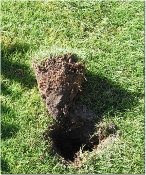 ushed out with my trowel and removed this divot. Can you see what I mean about thatch? It starts at the top and goes about two thirds down, to a depth of about 5 cm (2 inches).
But it's not the thatch we're interested in at this stage; it's the dark soil beneath it. I'm not sure if you can see, but it's still rather wet, but becoming rapidly drier. And because this weather is set to continue tomorrow, this would be a good opportunity for aerating the heavier ground (who knows what the weather might do next; and for how long?).
AERATING WITH A FORK
 The rows are similar to hollow-tining (shown here), but wider apart. However, the process is different.
Using my fork with the finest (thinnest) tines (a border fork), I drive it full depth into the turf, at a slight angle back from vertical.
On pulling the fork handle back towards me about 30 cm (1 foot), a layer of turf, at least 10 cm (4 inches) thick, is prised up on the tines. When the fork handle is raised and the tines withdrawn, this turf does not fall back completely (since it has been stretched), but remains slightly arched. Since the fork holes are in rows, the effect is to produce something like shallow drills of turf across the lawn, separated by the rows of fork holes.
It is the ARCHING which is important. The fine tines break a friable soil up easily, including any compaction (this technique is especially useful for areas of heavy traffic).
Aeration is achieved, firstly from the holes made by the fork; and secondly by the newly-formed cracks in the turf (caused by stretching).
IDEAL FOR LIQUID AUTUMN FEED
The holes are at the bottom of the ridges. So liquid feed can run straight into the soil, down to the roots. This is important for root formation, since phosphates (essential for root production) are, within a short time, nearly completely immobilised upon entering the soil.
And things get even better: rainwater can also get through the turf.
SPACING
About 25 cm (10 inches) between rows, for a small border fork, seems ideal.
FEEL THEM ROOTS
The idea is to get the fork in deep enough to reach beneath the roots. What I find is that this is easy in the heavier parts, where root formation has been limited by poor aeration. But one can feel the roots really resisting where the conditions for growth have been ideal. At this point, forking is not necessary; pricking will do, just so the water and feed can get through the turf.
LEAVE UNCUT
I really prefer to do this after the last cut, since it is important not to re-compress the turf. However, I find a small hover mower ideal, especially since the grass is best left longer so it has maximum length to produce food to fuel root production. I know it can thin the turf, but it is worth it at this stage.
HIGH POTASH FEED
Do not use summer feed; use a high potassium autumn feed. If you can't get a liquid (tomato feed will do), get a good brand of granules (this might contain a mosskiller and weedkiller).
P.S. Good news, thatch-wise: It's a lot softer than it was - the woody rhizomes have almost broken down (probably thanks to our early summer feeding).
And I think all gardeners and growers understand why a soil's water content plays a major role:
- too wet, and it turns into sticky 'plasticine', impossible to control
- too dry, to dust
However, there is a very narrow window of opportunity which presents itself as a soil dries out (thank goodness).
At this point, it forms into a ball when squeezed in the hand. And this ball breaks up easily when poked with a finger. This happens to all soils and composts which contain some structure to bind them (it is that same condition, ideal for propagating cuttings, described earlier). At this stage, the soil is said to be FRIABLE.
THIS IS THE IDEAL CONDITION FOR LAWN AERATION, especially by hand fork.
FABULOUS DRYING DAY
Today's weather came right out of the blue. The cold north-east wind is really drying things up, especially the lawn.
I r

 ushed out with my trowel and removed this divot. Can you see what I mean about thatch? It starts at the top and goes about two thirds down, to a depth of about 5 cm (2 inches).
But it's not the thatch we're interested in at this stage; it's the dark soil beneath it. I'm not sure if you can see, but it's still rather wet, but becoming rapidly drier. And because this weather is set to continue tomorrow, this would be a good opportunity for aerating the heavier ground (who knows what the weather might do next; and for how long?).
AERATING WITH A FORK
 The rows are similar to hollow-tining (shown here), but wider apart. However, the process is different.
Using my fork with the finest (thinnest) tines (a border fork), I drive it full depth into the turf, at a slight angle back from vertical.
On pulling the fork handle back towards me about 30 cm (1 foot), a layer of turf, at least 10 cm (4 inches) thick, is prised up on the tines. When the fork handle is raised and the tines withdrawn, this turf does not fall back completely (since it has been stretched), but remains slightly arched. Since the fork holes are in rows, the effect is to produce something like shallow drills of turf across the lawn, separated by the rows of fork holes.
It is the ARCHING which is important. The fine tines break a friable soil up easily, including any compaction (this technique is especially useful for areas of heavy traffic).
Aeration is achieved, firstly from the holes made by the fork; and secondly by the newly-formed cracks in the turf (caused by stretching).
IDEAL FOR LIQUID AUTUMN FEED
The holes are at the bottom of the ridges. So liquid feed can run straight into the soil, down to the roots. This is important for root formation, since phosphates (essential for root production) are, within a short time, nearly completely immobilised upon entering the soil.
And things get even better: rainwater can also get through the turf.
SPACING
About 25 cm (10 inches) between rows, for a small border fork, seems ideal.
FEEL THEM ROOTS
The idea is to get the fork in deep enough to reach beneath the roots. What I find is that this is easy in the heavier parts, where root formation has been limited by poor aeration. But one can feel the roots really resisting where the conditions for growth have been ideal. At this point, forking is not necessary; pricking will do, just so the water and feed can get through the turf.
LEAVE UNCUT
I really prefer to do this after the last cut, since it is important not to re-compress the turf. However, I find a small hover mower ideal, especially since the grass is best left longer so it has maximum length to produce food to fuel root production. I know it can thin the turf, but it is worth it at this stage.
HIGH POTASH FEED
Do not use summer feed; use a high potassium autumn feed. If you can't get a liquid (tomato feed will do), get a good brand of granules (this might contain a mosskiller and weedkiller).
P.S. Good news, thatch-wise: It's a lot softer than it was - the woody rhizomes have almost broken down (probably thanks to our early summer feeding).
23 September 2010
The Problem With Lawn Sand for Moss Control
If you're wondering whether you can use lawn sand as a source of ferrous sulphate to control your moss, I would say 'Yes - but there are considerations'.
Several have asked why I make such a big thing about using 'ferrous sulphate'. Why don't I just say 'Lawn Sand'?
Simple. Ferrous (iron) sulphate can be bought in various forms:
- as the chemical - ferrous sulphate, sulphate of iron, or iron sulphate
- combined with sand and feed as spring or autumn lawn sand - often with a weedkiller thrown in
I know it seems to be getting complicated. But it's not really.
Basically, if you can, I recommend you buy it on its own, not as lawn sand. This is not because lawn sand will not kill moss. It will - very well (don't forget to use the autumn lawn sand at this time of year; you can use spring lawn sand up till the end of August). And with the feed and the weedkiller, it is good value-for-money. But there is a problem:
GIVING SEVERAL APPLICATIONS
Because it is difficult to kill moss completely at one application (some of the dormant spores germinate later), the lawn might need more than one treatment, maybe even more.
Obviously, if the ferrous sulphate comes complete with feed (as it does in lawn sand), then this too will be added more than once. This is the problem, especially at this time of year. And of course, even if the lawn could cope, there is still the cost of the feed (and probably weedkiller) to be considered.
FANTASTIC HEALTHY TURF
 I have found Vitax 'Green Up Mossfree' (based on ferrous sulphate crystals) to be especially effective, not only at killing moss, but also in conditioning the lawn. Although it looks bad for a day or two, it soon becomes fantastic healthy turf.
In previous years, I have used it in August at the first sign of moss (as already outlined elsewhere). Because there is no feed, it can be given at this time and the blackened moss raked out.
This is a great plus. Because in August the lawn is still growing strongly. So even if there is much moss, the turf will green over again before the winter. Otherwise it means staring at something resembling the dark side of the moon until next spring.
And there is still time to re-seed if necessary (this should be left one month after treating moss). If moss is treated in September or October, seed might not germinate till the following year.
So the pluses so far are:
- It can be used as early as necessary to nip moss in the bud before it becomes too established and unsightly
- Further treatments can be given right through the winter, if necessary, without further raking (since there won't be much moss)
- Re-seeded turf will rapidly green up the same year, usually within a few weeks
And there's more:
- easy to store
- can be applied by watering can (you don't need a spreader)
- can be used at any time of year, even in the summer (and you don't need one for spring and another for autumn)
CAN ALSO BE USED AS A SPOT MOSSKILLER
Once I have treated the whole lawn, I treat the odd re-emerging patches with some of the mixture in a hand spray. This kills the moss without leaving dark green feed patches.
Some have said that 'Green Up Mossfree' is not available in their local garden centre. Can ferrous sulphate be bought in any other form apart from as a component of lawn sand?
SEVERAL FORMS
Yes. It can. Ferrous (iron) sulphate is the same chemical as 'sulphate of iron' (used as a plant tonic). However, as you'll see, we need to watch the strengths, which differ for different products (wouldn't life be simpler if manufacturers made their products uniform? I suppose that would be too easy).
If you're lucky and have a horticultural supplier nearby, you can buy ferrous sulphate in 25kg (55lbs) bags. But you will need to ask about the application rate. It is not as strong as 'Green Up Mossfree' (I often feel this can be diluted anyway - 'Green Up' contains 55.5% w/w ferrous sulphate, more than twice as strong as some products).
THE NEGATIVES
There don't seem to be many:
- this way works out more expensive because you will then have to buy an autumn lawn feed. I would say it is getting rather late now for weedkiller
- Green Up contains no sand to help keep the turf open
If you can't buy 'Vitax Green Up Mossfree' ask your supplier to get it for you. You won't regret it. It really is that good.
17 September 2010
Dealing With Moss
Reply to comment:
'Can u please tell me that how can we treat this disease.....
By Acidity on Testing the Soil Acidity on 12/09/10 '
Thank you for your comment.
Moss control in my lawn has been covered in several posts throughout the year. I used to have a really bad problem, but after applying the treatments outlined it has almost disappeared. In fact, it hasn't made any appearance this year so far.
If you click the 'moss' link at the side, you will see some of the posts. But to give you an indication of the techniques, they are really concerned with the following:
- controlling acidity
- preventing waterlogging and creating aeration (spiking)
- starting treatment at an early stage
- chemical control with ferrous sulphate
- removal of dead moss by raking
- thatch control
Now is a good time to start with moss control, if it is present in a lawn. Have a read of the posts and let me know if I can help you further.
Best wishes,
Jimini
16 September 2010
Dealing With Leatherjackets
I have seen a few daddy long legs (crane flies) attached to window panes, this week - a sure sign of leatherjacket trouble next year.
For anyone who has just seen a leatherjacket (thick rubbery brown-grey grub about 4 cm (inch and a half) long) for the first time, it is hard to believe that it represents the larval stage of the daddy long legs, let alone the sort of devastation these grubs can do to a lawn.
When you see the adult flies hopping over the lawn, they are laying hundreds of eggs in the damp turf. These quickly hatch into grubs which immediately commence feeding on young tender grass roots (exactly those we have nurtured for next year).
The damage goes undetected until the weather gets drier, the following year - the lack of roots causes premature browning and dying of the grass, which can then be easily pulled out in handfulls leaving almost bare earth. Further trouble is caused by starlings (and even animals such as badgers) and the like which scratch up the turf looking for the grubs.
Although both cultural and biological controls are possible, the worst of the damage will have already been done over the winter and spring months. So, even though the grubs can be killed, the lawn will not recover.
 Although expensive, I have found 'Provado Lawn Grub Killer' to be an excellent product for dealing with leatherjackets (it can also be used for chafer grubs). My lawn always used to have dead patches each summer before I started using it.
However, it is not the easiest of products to use, since it needs to be washed through the turf (to get to the grubs) without being diluted too much, or even washed right through the soil. Furthermore, because it is a powerful insecticide, it can only be applied once per year without affecting the balance of soil micro-organisms.
The best way to apply it is to wait until the soil has drained, then apply and wash it in with half an inch (1.5 cm) water from a sprinkler. You need to be confident that the weather will remain dry for two or three days to give the plant roots time to take it up, from whence it acts as an effective systemic insecticide.
If only the weather would settle down.
9 September 2010
Hollow-Tined Lawn
 Before top-dressing the complete lawn, I hollow-tined a small part comprised of wet heavy soil.
My lawn is a problem because the soil varies in texture from almost clay at one end, to almost sand at the other (yes, I know it's just right in the middle, and I can't have everything; but it's still difficult to manage).
I don't know if you can see (probably not) that the spacing between rows varies from about 10 cm (4 inches) to about 12.5 cm (5 inches). I only tined a few yards. I would have done more, but the tiner kept clogging up.
However, I feel that, provided water can get into the turf, the best time to aerate the lawn is after the end of cutting: and there's still over a month of this left, yet.
Nevertheless, I have found that deliberate aeration greatly enhances root growth. This is important, because I believe that the grasses grow a new root system each season. We are always starting each year afresh, so to speak.
Re-seeding
I added about 17.5 grams per sq metre (1/2 oz per sq yd) of grass seed before I applied the top dressing.
4 September 2010
Making a Thatch Sandwich - Part 2
I have just top-dressed the lawn. If you read this, you will see why:
We have seen that reducing lawn thatch can be achieved by:
MINIMISING THATCH AND MAT PRODUCTION
ENHANCING NATURAL BREAKDOWN OF THATCH AND MATT
Natural breakdown is undertaken by micro-organisms in the soil. Enhancement of this process is achieved by producing an appropriate environment.
acidity
We have already seen that the lawn has been limed to reduce acidity.
organic nitrogen feeds
Using nitrogen feeds in ammonium form (and feeds which can be easily converted to ammonium (e.g. urea)) rather than in nitrate form greatly helps the build up of micro-organisms.
aeration
Aeorbic micro-organisms (which are beneficial to our purpose) need oxygen to function. Pricking the turf facilitates this. Tining and hollow-tining has the same effect.
water content
Micro-organisms need the thatch to be damp if they are to break it down. They cannot work on dry thatch. Pricking also facilitates this. Top-dressing also helps to prevent the thatch from drying out.
TOP-DRESSING
Making the sandwich
Top-dressing involves covering the thatch surface (after raking) with a layer of soil - mixed with sharp sand and organic matter - which is worked into the turf and levelled. This helps prevent the thatch and mat from drying out, allows it to be attacked from both top and bottom (since it contains micro-organisms), and levels out any hollows.
Effectively, a new false soil layer is created, kept open by the sharp sand (not builders' sand). The organic matter (use of this is optional; it helps improve soil structure) can be garden compost sieved through a 1/4 inch sieve. The soil can be garden soil, also passed through a 1/4 inch sieve. The mixture is applied at the rate of about 1 to 1.5 kg per sq metre (about 2.5 to 3.5 lbs per square yard). Apply two or three times as much if you have hollow-tined.
Although it is easy to buy top dressing, it is better to make your own if possible. This way you can adjust it to suit your lawn conditions. For example, for a heavy, poorly-drained clay soil, you could use about 75% sand. On the other hand, a sandy soil might only need about 20% sand. It's up to you. You have much more control.
To level the surface, drag a straight piece of 2 inch by 4 inch timber over it, once you have applied the dressing.
Top-dressing not only levels the surface and improves breakdown of thatch and mat; it will stimulate the grasses to produce new side shoots, thus thickening the turf.
We have seen that reducing lawn thatch can be achieved by:
- minimising thatch and mat production
- enhancing the natural breakdown of thatch and mat
MINIMISING THATCH AND MAT PRODUCTION
- remove mower clippings
- avoid high doses of nitrogen feeds during first half of season - slow steady growth seems best
ENHANCING NATURAL BREAKDOWN OF THATCH AND MATT
- reduce acidity
- use organic nitrogen feeds
- improve aeration
- control water content
Natural breakdown is undertaken by micro-organisms in the soil. Enhancement of this process is achieved by producing an appropriate environment.
acidity
We have already seen that the lawn has been limed to reduce acidity.
organic nitrogen feeds
Using nitrogen feeds in ammonium form (and feeds which can be easily converted to ammonium (e.g. urea)) rather than in nitrate form greatly helps the build up of micro-organisms.
aeration
Aeorbic micro-organisms (which are beneficial to our purpose) need oxygen to function. Pricking the turf facilitates this. Tining and hollow-tining has the same effect.
water content
Micro-organisms need the thatch to be damp if they are to break it down. They cannot work on dry thatch. Pricking also facilitates this. Top-dressing also helps to prevent the thatch from drying out.
TOP-DRESSING
Making the sandwich
Top-dressing involves covering the thatch surface (after raking) with a layer of soil - mixed with sharp sand and organic matter - which is worked into the turf and levelled. This helps prevent the thatch and mat from drying out, allows it to be attacked from both top and bottom (since it contains micro-organisms), and levels out any hollows.
Effectively, a new false soil layer is created, kept open by the sharp sand (not builders' sand). The organic matter (use of this is optional; it helps improve soil structure) can be garden compost sieved through a 1/4 inch sieve. The soil can be garden soil, also passed through a 1/4 inch sieve. The mixture is applied at the rate of about 1 to 1.5 kg per sq metre (about 2.5 to 3.5 lbs per square yard). Apply two or three times as much if you have hollow-tined.
Although it is easy to buy top dressing, it is better to make your own if possible. This way you can adjust it to suit your lawn conditions. For example, for a heavy, poorly-drained clay soil, you could use about 75% sand. On the other hand, a sandy soil might only need about 20% sand. It's up to you. You have much more control.
To level the surface, drag a straight piece of 2 inch by 4 inch timber over it, once you have applied the dressing.
- If your soil is really heavy, hollow-tine or deep-tine first, then brush sandy mix into holes.
- Always make sure that the dressing is worked in: Do not leave it on top of the grass.
- This job is best done when both the grass and the dressing are as dry as possible.
Top-dressing not only levels the surface and improves breakdown of thatch and mat; it will stimulate the grasses to produce new side shoots, thus thickening the turf.
Making a Thatch Sandwich - Part 1
Ask most gardeners what lawn thatch is, and they'll tell you it's a layer of loose dead material on the soil surface comprised of old leaves, dead grass and other miscellaneous rubbish collected over the years. Furthermore, the way to deal with it is to give a good hard raking (with a hand rake) in the autumn and, 'Bob's your uncle', problem solved.
Really?
I wouldn't like to tell you just how hard I raked my lawn, blisters and all. Barrow loads of dead material. But no good. Problem still there. It took years to discover why.
JUST WHAT EXACTLY IS 'THATCH'?
Yes, my lawn did have a loose layer of dead material. And this could be removed quite easily. But I was always frustrated to discover that I could never see the soil surface; I had imagined that if I raked hard enough, this would eventually show through. No. All that was there was a dry corky substance.
I don't know why I didn't think of removing a divet of turf (probably because I always thought it would disfigure the lawn). However, when I finally did, I could see quite clearly that this corky layer was about 3 cms (over 1 inch) thick. And it wasn't only comprised of old leaves - it contained dead and live wiry rhizomes (underground stems) twisted into a dense mat. No wonder I was getting nowhere with the hand rake.
A mechanical raker helped somewhat. But unfortunately there was virtually nothing left of the lawn. Yes, it seemed to recover (though I doubt that all lawns would recover without re-seeding). But it looked awful for much of the year. And the problem never seemed to improve.
Now I am trying a new approach:
So, to recap, the term 'thatch' is confusing. Apart from loose dead material on the surface, there is often a dense mat beneath the surface, which is much harder to deal with.
Really?
I wouldn't like to tell you just how hard I raked my lawn, blisters and all. Barrow loads of dead material. But no good. Problem still there. It took years to discover why.
JUST WHAT EXACTLY IS 'THATCH'?
Yes, my lawn did have a loose layer of dead material. And this could be removed quite easily. But I was always frustrated to discover that I could never see the soil surface; I had imagined that if I raked hard enough, this would eventually show through. No. All that was there was a dry corky substance.
I don't know why I didn't think of removing a divet of turf (probably because I always thought it would disfigure the lawn). However, when I finally did, I could see quite clearly that this corky layer was about 3 cms (over 1 inch) thick. And it wasn't only comprised of old leaves - it contained dead and live wiry rhizomes (underground stems) twisted into a dense mat. No wonder I was getting nowhere with the hand rake.
A mechanical raker helped somewhat. But unfortunately there was virtually nothing left of the lawn. Yes, it seemed to recover (though I doubt that all lawns would recover without re-seeding). But it looked awful for much of the year. And the problem never seemed to improve.
Now I am trying a new approach:
- minimise thatch and mat production
- enhance natural breakdown of thatch and mat
So, to recap, the term 'thatch' is confusing. Apart from loose dead material on the surface, there is often a dense mat beneath the surface, which is much harder to deal with.
28 August 2010
Lawn Action in August
Reply to comment:
'What action do you take in August?
By Anonymous on Moss in Lawn on 25/08/10'
Thank you for your comment. As far as the lawn is concerned, if you look in the blog archives, you will see that I posted a 'Moss Alert' on 6th August which alerted readers to the dangers of moss getting hold at this time of year. If you look at the post, you should find links back to other lawn articles which will outline moss and other lawn jobs. Also, if you look at the categories at the side and click the 'lawn' link, you should find all the lawn posts.
There was also a lawn posting yesterday which was written before I read your comment.
The Lawn in August
August is in many ways a strange month, certainly as far as a lawn is concerned. Temperatures are still reasonably high, and provided there is sufficient moisture in the ground, growth should be quite strong. It is therefore a good opportunity for a lawn to recover from the hot often dry summer months (especially this year). High nitrogen (these should also contain some phosphates and potash (P and K)) feeds can be given up till the end of the month, which will really help the lawn recover.
However, there is also a downside. Overnight dews combined with high temperatures provide an ideal breeding ground for fungal diseases. You will see that I have had problems with 'Dollar Spot' disease (apart from the blight on the tomatoes). This has been largely dealt with by raking it out somewhat prematurely. This operation has been mostly successful, though there is still a little bit left. This disease is not fatal (it only affect the finer grasses, anyway); it merely disfigures the lawn for a while.
And of course, there is moss, the bane of my life (one of them). Warm dewy nights are also ideal for spore germination. Moss is sneaky and can suddenly appear, as if from nowhere, as I am sure you are well aware. So I really do advise you to be on the lookout for it.
I limed my lawn this summer (see 'Keeping it Sweet') to help with my moss problem. And, touch wood, this seems to have worked, at least so far. Usually I have had moss before now. But the lawn seems clear. Hope I haven't spoken too soon.
Removing acidity (by liming), and improving drainage, can each help tremendously with the moss problem (liming is best done early in January).
If you look back at the summer lawn posts, you will see that I spiked the lawn to aid water penetration (look under 'lawns', 'watering' and 'water conservation'). Water penetration can be prevented either by a thatch on the surface or by compacted dry soil beneath. Spiking, or pricking punctures the surface to allow the water through it.
A good technique is to go further than this and push a fork further down into the soil (as I did in the summer). If it is wiggled around, in the right conditions, it will break up compaction. But there is a downside: The soil needs to contain the right level of moisture, otherwise it can do more harm than good (this will be explained soon). Furthermore, because it breaks the root system, we need to be sure that the grass can recover quickly enough by growing new roots. For these reasons, I do not recommend deeper tining at this time (best to wait till further in September). Stick to pricking, spiking or shallow tining if you can.
If the soil is really hard - so hard that water just cannot penetrate (as it has been this year) - I push the fork deep into the soil just to make a hole, but do not wiggle it. This way, root damage is minimised, and the water has more chance to get deeper down to where it can begin wetting the lower levels.
The other thing which is good is Hollow Tining (provided the ground is not too hard), which I briefly touched on in a previous post.
If there is one thing I want to teach you about growing, more than any other, it's that we need to do things when the plant dictates, not the calendar. I know there are good arguments for doing things at the appropriate time. But nevertheless, this should be dictated by the plants. Times have changed. Seasons have changed. Methods and opportunities have changed. Equipment has changed. It's all changed from how it used to be years ago. We need to bear this in mind, yet still consider the wisdom from the past.
As the autumn progresses and the nights draw in further, the lawn detects this and changes its growth pattern from producing leaves to producing roots for next year. I have just given my lawn a feed which should be enough for leaf growth this year and give the grass a good start into the autumn when we can concentrate on the roots.
So, to sum up, make sure the drainage is good on your lawn and that water can penetrate down into the soil, ensuring any winter rains can get away without waterlogging the surface. Get on top of the moss, rake out any thatch and dead grass if necessary.
I hope this will be useful.
Best wishes,
Jimini
Subscribe to:
Posts (Atom)