Learning how to water plants to increase growth in pots, container or garden - especially how to water roots and tubers. Specialities: root growth or tuber growth of lawns, fuchsias, geraniums, dahlias and begonias.

Showing posts with label coriander. Show all posts

1 July 2011

Insects Help Coriander Pollination

insects useful in coriander pollinatonNot only bees are useful in gardens; smaller insects are especially useful in assisting pollination of coriander flowers (as with tomatoes, misting with water and tapping the stems also helps).

Apart from the fact it has toppled over (like trees), presumably because it is top-heavy due to too much feed in the new compost (too much for this stage of growth, that is), the recently-potted coriander is doing quite well . . . considering.

I have only tied up half of the stems and left the other half horizontal, resting off the floor. The plant is still indoors. See what happens . . ..

17 June 2011

Coriander Severed Roots After 11 Days

new coriander rootsThese brand new roots, complete with root caps, have appeared sooner than expected (see 'Coriander 'Multi-Plant' Matted Root Trim').

Plant has been kept un-watered, at about 17 deg C, indoors and in good light. Compost still quite moist, so should not need watering for perhaps another week (provided it remains indoors); it's just about at right stage for root and foliage growth right now.

coriander flowers on multi-plant in plastic cupFlowers seem to be developing quite well, for now. Newer growth looks fresh and healthy. Not sure if stems are becoming wavy (below)? Wait and see . . ..
wavy coriander stems?

10 June 2011

Coriander 'Multi-Plant' Matted Root Trim

coriander matted roots at base of multi-plant cupThese matted coriander roots are on a plant from a 200ml plastic cup found under bench. Discarded when it began going to seed, it has not been watered for some time. Compost was virtually bone dry and foliage had almost - but not quite - gone. Original intention was to confirm Ken Pilkington's findings that 'Multi-Plant' (his name for a plant community in a pot) roots remain fine and fibrous, not thick and tap-root-like.

coriander matter roots removedAfter severing and removing matted base roots, plant was placed in a 4.5 inch pot of plain compost to same depth it was in 2.5 inch cup. Note how much inner compost is unused. Idea is to utilize this as well as new compost.

coriander after potting upI know photo is not very good, but a few flowers already forming on stems in pot. Should be interesting to see if it will revive (plants do not usually thrive if they have suffered a severe setback) and how efficiently it can produce flowers. I think a 'Multi-Plant' has great potential in this area (certainly has in the fuchsia area), capable of easily producing many flowers and seeds on relatively compact, stable plants.

20 May 2011

Feathery Coriander Leaves

feathery coriander leaves are a sign it is going to seed
When coriander leaves become deeply fissured and take on a feathery appearance, the plants are running to seed. Although still edible, they become bitter. This happens from this time through till August in the UK.

I am not sure what causes this. Some say it's the hot weather. But I don't think it is. Coriander seems to grow normally during hot Augusts. So it could be caused by shorter summer nights (i.e. it's a 'photoperiodic' response (induced by daylength)).

Photoperiodism is common in plants in temperate regions where seasonal climatic differences exist; but I don't think it's so common in Mediterranean plants, as I think coriander is. I could do with some advice on this.

Plants constantly manage daylength using phytochrome in their leaves. Their many activities never cease to amaze me.

14 May 2011

Severing Coriander Roots Improves Growth

some coriander plants have now caught up with controlSince last month, most of the coriander plants with severed roots* have caught up with the control (red). It looks as if severing the roots - thereby inducing earlier lateral root production - can substantially improve growth.

The pot was left without water for a short period, so things have not been ideal. But, provided the plants do not run to seed, it will be interesting to see what happens from now on.

IMPLICATIONS FOR POTTING UP
Many growers pot their plants up into larger pots as soon as the primary root(s) encircle the base of the pot. Instead of this, why not break the root(s) off. The plant could then be left longer in its pot and produce a better root structure which should ultimately lead to a stronger plant.

I have always teased away excess roots encircling the pot of pot-bound plants, then broken it off before re-potting. Until recently, I thought everyone did this.

IMPLICATIONS FOR POTTING DOWN
Who said you 'can't squeeze a quart into a pint pot'? Not me. Not any more. What I mean is that it might be possible to quite severely trim the roots and re-pot a subsequently improved plant into a smaller pot. Of course, exhibition growers have done this for years. I am beginning to see why.

* plants with roots severed half way down the pot, and below

14 April 2011

Coriander Root: No Discussion

new severed coriander root Thought it strange what happened to that severed root. You know - the one in the plastic pot. So tried something else. Planted another pot, then severed all-but-one root, each in a different place and at a different stage: some before reaching pot bottom, others after. Not conculusive. But two things likely:
  • even though root was severed before it reached the bottom (so, presumably, before it came into contact with other roots), it is still apparently alive (white) after 8 days
  • relative to the control unsevered root, there seems to have been quite a check to growth on the other plants, even though they have developed good lateral root systems (however, as you can see, these roots have thrown good lateral roots above the cuts)
I wanted to see how much this check might be. Now we know. Since no contact between roots in this case seems likely (because I cannot see any), there's little chance it could have been fed by a neighbour. Probably being sustained by sugars present before it was severed. Anyway, at least we have seen the check to growth. So it hasn't all been in vain.

Pot been deliberately kept on dry side. So now want to see what happens once it's watered. Will extra lateral growth of severed roots allow them to catch up, in time? Let's wait and see....

P.S. Little change in condition of root in original pot.

7 April 2011

Severed Coriander Root Dying After 29 Days?

Something has happened to the coriander root severed 29 days ago. The severed half seems to be dying.

severed coriander roots are dying and going brown Sorry about the photo. But the severed base of the old root (red) has suddenly begun to wither at the top. Strangely, it still seems white at the base, presumably where it's attached to the other roots. However, what I don't understand is why the base of the new lateral side shoot (pink), attached to the original intact root, is turning brown at its base. Since it seemed so strong and healthy, I would have expected it to be pristine white.

Seems strange one is withering at base, other at top. i.e. Both are dying in roughly the same part of the cup. Could there be something (perhaps a toxin of some sort) causing this? I don't know. But what I can say is that there's no compost behind the roots in this area, so it might have caused too much desiccation (drying).

However, it's unlikely, since roots do not normally turn brown and begin to die when they reach an air pocket; they just stop growing and hang around in limbo. Mysteries, mysteries.

P.S. Have started another pot of coriander and have cut the roots in several places. Tell you about this later . . ..

P.P.S. Rising temperatures means now watering about every 5 days. Look at how much this watering has stimulated root growth.

1 April 2011

Coriander Re-Pot Increases Growth Rate And Leaf Size

The time has come to give the coriander roots more space - time for a re-pot (see last year's post). Although this is not absolutely necessary, a larger root run will vastly increase both growth rate and leaf size. And we need to get a move on now so we can cut the crop before it goes to seed, as it does in early summer. coriander now ready for a re-potIf you want to keep a plant growing, keep the roots growing. Once this stops, growth stops. As you can see, the roots are beginning to fill the pot, so growth will be slowing down. Most growers re-pot in half inch stages, saying this helps fill the pot better. They also use additions to the compost, such as grit or perlite, to help avoid over-watering. I have never done any of this - I have always used plain multi-purpose compost. Provided it is not compressed too much, and provided it is allowed to dry out adequately between waterings, there should be no problems. I am not saying there are no benefits to compost additions - there will be. But growing, to me, is about keeping things simple and cheap. Re-potting can be done as per last year. A frost-free spot in the garden would also be ideal. If you want to cut costs, try mixing about half compost, half garden soil. Because of the severed root, I am not re-potting this pot. The severed root seems to be still alive, and the new root buds formed on the other half are starting to grow.

24 March 2011

Severed Coriander Root Still Alive After 15 Days?

root buds forming on severed coriander root15 days ago, one of the coriander roots was severed half way up, shown here by the green arrow.

I cut the root to see what effect this would have on branching. As indicated last week, unlike the other roots, it initially produced just one lateral branch, although this was longer than those on the other roots.

Now, 15 days later, two new lateral buds (indicated by red arrows) have also appeared.

severed root still alive after 15 daysHowever, what's even more surprising is that the severed base of the root still seems to be very much alive, complete with pristine white root hairs. Once again, the question arises as to how it is sustaining itself without obvious connection to a leaf as a source of food?
  • There is a clean break, so the root has not just healed up and continued as normal.
  • There is not much water on the side of the cup, so it is unlikely that nutrients have diffused to the root this way.

the roots have grouped at the bottom of the potIt does seems that it's either using sugars previously stored, or it's being fed from the other unsevered roots. As you can see, these have formed a nice group at the base of the cup and are clearly in contact with each other.

What we have here is a community of coriander plants, just as we had with the 'Multi-Plant' * fuchsias.


* The term 'Multi-Plant' is what Ken Pilkington, a fuchsia grower and ex-exhibitor, called this technique of growing several plants in one pot. He found that when he did this, his fuchsias changed their growth habits as they formed communities, and he described these in his excellent book 'How to Grow Fuchsias - A Practical Guide'. I don't want to get into fuchsias here, as we shall be covering these soon elsewhere. But mention is justified because we have a coriander 'Multi-Plant' community, and the effects discovered could be the result of inter plant communication within this community. All we have to do is prove it . . ..

    Coriander First Water After 43 Days

    watered coriander showing first true leavesAs with the lettuce, the emergence of first true leaves (arrowed) indicate it is time to transplant to provide more room and better compost for the coriander seedlings. We're not doing this. As mentioned elsewhere, we are going to keep them as a community, just like last year.

    Because the cup is getting rather light, and there is little condensation left on its sides, I applied the first water since planting 43 days ago. A good soak now and then is usually preferable to little given often, since it allows the compost to draw in vital oxygen from the atmosphere to replace the water lost as the compost dries out.

    I gave about a quarter of a cup (50 mls) of plain water. Still too early for feed.

    It is unfortunate that this is the cup with the severed root described earlier. I would have preferred to keep the side of the cup dry. Never mind.

    17 March 2011

    Coriander After 34 Days

    coriander showing first true leaves after 34 daysCoriander just starting to develop true leaves. Sorry for delay. Things been slow because of low temperatures.

    Although we have not yet reached the traditional pricking out stage (we are very close), look at how much root development there has been. It would be impossible even now to remove these plants individually from the compost without breaking the roots, probably causing a setback. Well, don't worry. We are not going to remove them.

    Incidentally, it was this thought of breaking the roots which caused me to have a look see just what would happen if they were broken.

    THE PLANTS HAVE NOT YET BEEN WATERED.

    Severed Coriander Root

    coriander root severed half way upThis is the root development story 27 days after planting the coriander. Development has been slow because the temperatures have been cut right down. No matter. I wanted to see if severing a root induces branching. So I took a craft knife and pushed it through the side of the plastic cup, cutting one root in half. No lateral roots had developed on any of the roots at this stage.

    coriander root branches8 days later, the result is not as expected. Although the severed root (left) has apparently developed one long lateral root at its base (top), the remaining two unsevered roots seem to have developed more, and these are distributed along the full length of these roots. It's difficult to determine this definitively, since lateral roots could be hidden in the compost behind, out of view. But there does seem to be a difference in development.

    It also seems that the lateral on the severed root is following the moisture level of the compost down the cup as it dries. This could lead to an interesting insight into watering techniques for optimum root development.

    I was also fascinated to discover that the severed base has not died off, but is still apparently in full health, albeit not growing. How is it doing this? What is it living on? Had it already got some food reserves passed down from up above? Or is it be being fed from the other half, through an inter-root connection? Stranger things have happened.

    P.S. If you are wondering why I am so interested in roots, see 'Roots Are Hoots' from last year.

    10 March 2011

    Displaced Coriander Seedling Shows Geotropism At Work

    The main roots on both the coriander and the lettuce have now reached the bottom of their cups. No water given yet. We shall soon be returning to this for a fascinating insight. For now, I want to tell you about GEOTROPISM - a plant's growth response to gravity.

    Shoots grow away from gravity and are said to be NEGATIVELY GEOTROPIC. But roots show POSITIVE GEOTROPISM, growth towards gravity.

    coriander seed uprooted at germinationJust a couple of weeks ago, all seemed lost for this germinating coriander seedling. The seed case had been pulled out of the compost during germination; the root lay prostrate on the surface, its tip facing upward.

    coriander seed determined to surviveExamine the seed's response in its struggle to survive (right). Notice how, 28 days later, the root hairs have anchored the root (radicle) to the surface of the compost, allowing its tip to be thrust downwards to access water and food from the compost. Meanwhile, the cotyledons (seed leaves of developing shoot) are struggling free from the seed case (testa) and are thrusting upwards towards the light.

    It's amazing just how resilient, resourceful and determined plants are. It seems they will do everything they can to survive any situation. And I do mean ANY situation. If only they had a brain . . . .

    24 February 2011

    Coriander After 16 Days

    coriander roots after 16 daysCoriander roots are now about 3.5 cm (1.5 inches) long. They have done well to make so much growth in 4 days at such low temperature.

    This is a tap root system; it will be forming lateral roots soon. Since coriander comes from a hot dry climate, a taproot system is ideal to access deep water and nutrients.

    coriander leaf after 16 days Things are starting moving on top, now. The hooked hypocotyls have turned green and the cotyledons (seed leaves) are about to emerge from the seeds.


    WHAT'S THE POINT?
    The point I want to make by showing you all this is that seed development is deceiving. Were it not for the fact that we can see the roots, we would never believe they had developed to the extent they have. This is why novice growers over-water seeds: As the compost dries on the surface, they believe the roots are still too short to access water deeper in the compost. They are not.

    21 February 2011

    Coriander Seeds After 12 Days

    I know I showed you this last year. But its so important we should revisit.

    coriander rootscoriander roots 4 days agoIn 4 days, and although these coriander seeds in the plastic cup (left) have been placed in a much cooler spot (average temp. about 5 deg C), the roots (radicles) have doubled in size (compared with right, taken 4 days ago) and are now about 2.5 cm (1 inch) long.

    Novice growers are often amazed to see so much root development with hardly anything happening above ground. And because we can also see water droplets on the side of the cup, we know the seeds do not need watering, no matter how dry the surface gets. This is wonderful, since we can now at last avoid the 'cardinal sin' of OVER-WATERING, and quickly develop a good watering technique.

    BUT THERE'S MORE . . .
    I don't know about you, but I was surprised to see coriander growing in such cool conditions. Although, having said this, it is mostly the root which has grown. This is good. Because a low temperature produces stronger, healthier plants.

    Note: Coriander seeds are unusual in that they seem to produce two plants per seed (there would normally be only one root (radicle) per seed). No one ever seems to mention this. A coriander seed produces two radicles, each of which will develop into a separate tap root.

    17 February 2011

    Coriander In Cups After 9 Days

    coriander seeds after 9 daysThe coriander is only just germinating after being kept at about 15 deg C for 9 days. I removed the cover on the second day. Note that the seeds are still very moist, perhaps even too moist.

    10 February 2011

    Planting Coriander Seeds

    Coriander is easy to grow on a windowsill. And now is a good time to plant it so that it has time to mature before June. Although it will grow all year round from seed, it tends to be difficult to grow in the summer, as it runs to seed itself very easily during the hotter months.

    I am using 200ml clear plastic drinking cups. These have several advantages for growing seeds, especially for coriander, where small plantings can be made at weekly intervals (or whatever interval is most suitable) throughout the year without taking up too much space. Using these cups is also an ideal way to learn how to grow, since we can see exactly (well, ALMOST exactly) what is happening beneath the surface of the compost, and we can have a better idea of what watering is all about. I outlined the benefits last March in 'Seeds in a Cup - Background'.

    THE TECHNIQUE

    The technique used to grow basil last year, outlined in 'Growing On A Windowsill', was successful for coriander (though, unfortunately, not for the basil). I am using it again here with slight modification.

    making hole with awlAn awl is a good tool to puncture the cup as near to the base as possible, so that the hole is visible and is not actually beneath the cup (where it would be blocked). It doesn't have to be too large, since - contrary to rhetoric - water will drain quite quickly even from the tiniest hole (smaller holes are also good for outside use, since they prevent slugs and other pests getting into the pots - just thought I'd mention that)

    coriander seeds covered with clingfoilUse about 20 seeds and press them, evenly spaced, into the compost as far as you can without compressing it too much. Don't forget to place one or two at the edge so you can see the roots growing down the side of the cup.

    You don't need to cover the seeds with dry compost. What I do is cover them for about a day or two with clingfilm. But I make sure that there is a hole in this film to prevent excessive humidity. Drops of water on the film first thing in the morning is O.K.

    Place in a south-facing shallow windowsill in good light (direct sunlight is O.K. but watch for excessive drying and heating). This should keep the cup about 18 to 20 deg C (64 to 68 deg F) - you don't need to be too fussy. It is good if the surface of the compost dries a little, since this will draw air in and help avoid disease, but make sure seeds themselves remain at least partly damp. If you scratch the surface of the compost, it should be damp just beneath the surface. Spray with water if necessary. Otherwise, after 3 or 4 days, the seeds should be moist enough (they turn darker in colour) and spraying should not be necessary.

    You should see the seed cases bursting open after 4 or 5 days.

    If you haven't got a south-facing windowsill, start seeds off in a warm spot, but place cup in a cooler spot (about 15 to 16 deg C) once they start germinating.

    Watering should not be necessary for a couple of weeks.

    Click here to see last year's coriander posts.

    6 January 2011

    Coriander Canary Detects Low Light

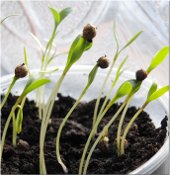
    etiolated coriander seedsAll seedlings will etiolate (stretch) if the light intensity is too low. The coriander here is no exception. I have been germinating seeds at room temperature (a cool room), then cooling down to 7 to 8 deg C (44 to 46 deg F) during December (see growing coriander notes).
    normal coriander seedsAs you can see from this photo, things were going fine until last week when the mild foggy weather reduced light levels and increased temperatures to 10 deg C (50 deg F). The etiolation (shown above) happened overnight.

    This tells me three things:


    • coriander will actually grow at low temperatures - far lower than I expected

    • most of the winter light is acceptable at these temperatures - it is just the odd fluky day (fog and heat) that can cause problems

    • it is still too early to plant most seeds - best wait till the light improves
    Because of coriander's tendency to bolt (start forming seeds) during the summer months, if you want just the leaves it is best to plant seeds in small numbers at weekly (depending upon how much you require) intervals. The technique of growing seeds in plastic cups which I introduced last year has proved an ideal way to do this (have a look at the 'seeds' category or read the March 2010 posts).

    The etiolated seedlings will still develop and will not be wasted. So it is worth planting a few seeds, just to be sure of adequate light levels.

    P.S. I would love to know what fungus is growing on the compost. It doesn't seem to affect the coriander.

    4 May 2010

    Coriander Finished

    Just as it was starting to get going after re-potting, the coriander has started to bolt (run to seed). So cut up and put in freezer. Still, we have had our money's worth out of it.

    Coriander is notorious for bolting at this time of year, but this variety was supposed to be resistant. Just shows that we cannot always go by what is written on the packet.

    Seeding is mostly a photoperiodic (controlled by daylength) response. Had the season been a bit warmer, there would have been a much heavier crop by now. Maybe next year?

    19 April 2010

    Re-Potting Coriander

    The Coriander has grown too big for the tiny plastic cup. It needs watering every couple of days, and the leaves are looking rather small. I thought it might be a good idea to put it into a larger pot to allow it to develop to its full potential. I have used a 13 cm (5 inch) pot, plus my old potting compost I am trying to use up.


    I find it best to use an empty pot of the same size to make the hole in the compost. It is easier to add compost around it when it is empty. This compost is rather too wet. I was afraid of drier compost collapsing into the hole when I removed the pot (Ideally, the compost should be just changing colour).


    put roots into hodeThere is a good root growth here. Take care not to disturb the sides of the hole when inserting plant. And give sides of pot a good tapping and light downward bashing onto work top to make sure compost has made good contact with roots. If the tap root is running around bottom of pot, it should be broken off. This will encourage development of secondary fibrous roots.


    This process usually makes a fantastic difference to growth rate.